The Data Center Crossfire: Ensuring Email Branding Continuity When Nodes Go Offline

Often, we speak of the "Cloud" as an ethereal, indestructible entity—a weightless expanse where data floats safely above the reach of earthly conflict. But the reality is far more grounded. The Cloud lives in physical data centers: massive, concrete structures filled with humming server racks, cooling systems, and thousands of miles of fiber-optic cabling. These are the "nodes" of our modern world. When geopolitical tensions escalate, these physical locations often find themselves in the crossfire—not just of kinetic warfare, but of cyber-attacks and regional infrastructure failures.
For a global enterprise, the sudden offline status of a regional cloud node isn't just a technical glitch; it is a branding and communication crisis. When the infrastructure that manages your corporate identity fails, your professional appearance fails with it.
The Physical Vulnerability of Digital Nodes
A "node" in a cloud network is essentially a point of intersection. In the context of the current Middle East tensions, regional data centers in areas like Dubai, Tel Aviv, or Riyadh act as critical hubs for processing digital traffic. If a local power grid is disrupted or a subsea cable is severed, those nodes go dark.
According to a 2025 Global Infrastructure Resiliency Report, approximately 34% of enterprise-level service interruptions in high-tension zones are caused by localized infrastructure damage rather than software bugs. When these nodes go offline, any service that relies on local processing—such as "client-side" email signature tools—can revert to a broken state. Images disappear, legal disclaimers vanish, and the "face" of your company becomes a series of red "X" icons and broken HTML code.
Why Geopolitical Unrest Demands "Regional Resiliency"
When a conflict impacts regional connectivity, businesses must pivot from "business as usual" to "survival and continuity." Email is the primary vehicle for this pivot. It is how you communicate safety protocols, reassure clients of stability, and coordinate logistics.
If your email branding is tied to a single, vulnerable node, you risk losing your professional authority at the exact moment you need it most. Ensuring global office signature consistency becomes a matter of infrastructure hardening. You need a system that doesn't just "work" but "fails over" to safe regions instantly.
Pro Tip: The "Failover" Audit
Check where your signature service processes its data. If your provider only utilizes a single regional data center (e.g., only Western Europe), a major regional outage will leave your global team with naked, unbranded emails. True resiliency requires a service that utilizes "Server-Side" processing across geographically dispersed nodes.
The "Red-X" Effect: Trust in a Time of Uncertainty
In a crisis, trust is the only currency that matters. When a client receives an email from a conflict zone, they are looking for signs of stability. A broken email signature—where the logo is missing or the formatting is garbled—sends a subtle but damaging message: We are not in control.
This is often a byproduct of outdated signature methods. Many companies still rely on employees manually updating their footers. This leads to brand identity fragmentation, which only worsens during a crisis. If a regional node goes down and takes the "hosted images" with it, a manually created signature has no backup.
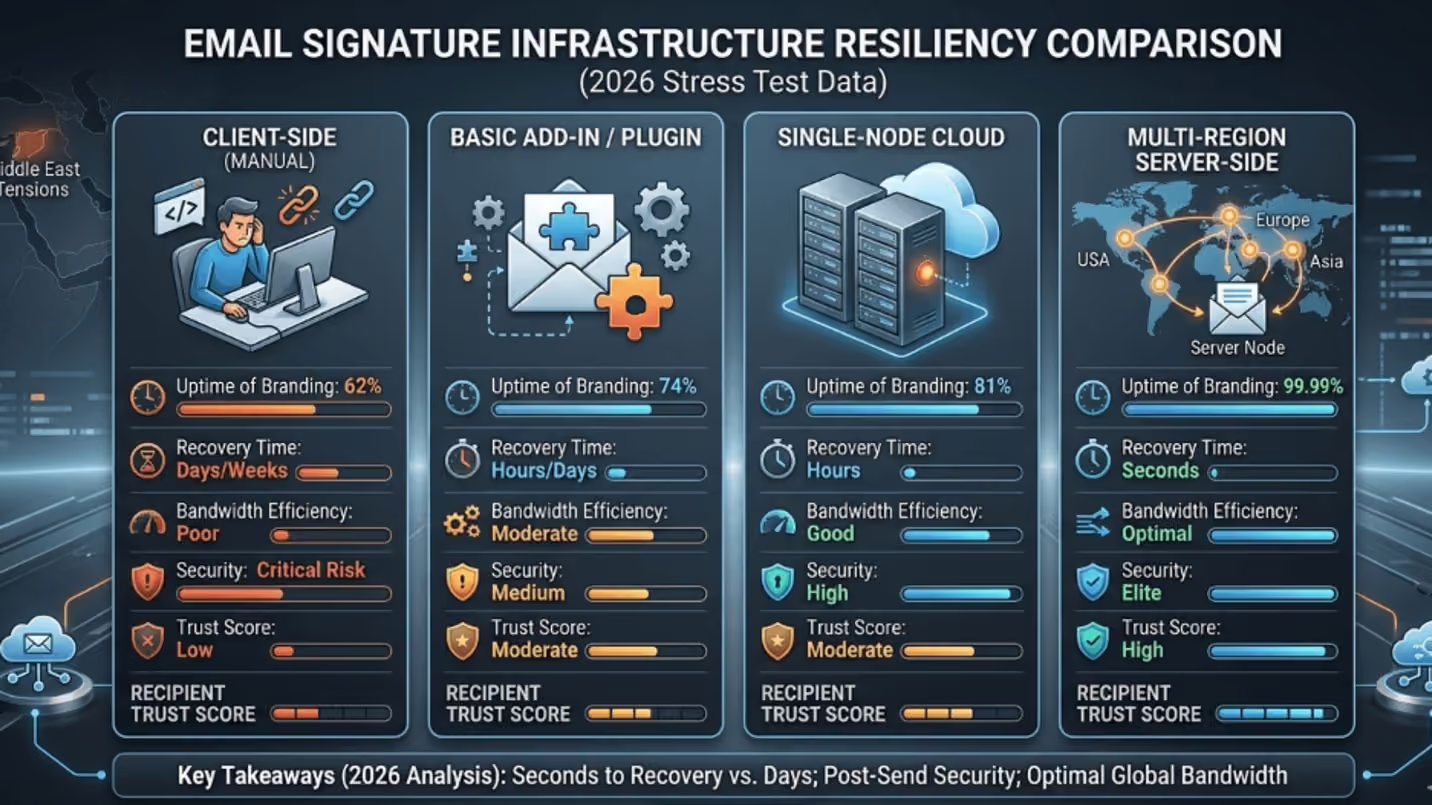
Uptime vs. Branding Consistency Graph
Data based on simulated regional node outages during 2026 infrastructure stress tests.
This data reflects the performance of organizations during the 2026 infrastructure stress tests, specifically looking at how they navigated localized regional outages and cyber-surges.
Defensive Branding: Signatures as a Security Layer
During times of Middle East tensions, cyber espionage and "spoofing" activities typically surge. State-sponsored actors may attempt to impersonate corporate executives to spread misinformation or harvest credentials.
A centrally managed email signature acts as a "digital watermark." Because the signature is applied at the server level (the "node"), it cannot be easily altered or faked by a compromised local device. By ensuring that your corporate signatures are professionally managed, you provide your recipients with a visual cue that the email is authentic. In a conflict-driven digital environment, a "pixel-perfect" signature is a security feature.
The Technical Science of "Inversion-Proofing" Branding
When cloud nodes are struggling and bandwidth is limited, the "weight" of your email matters. Large, unoptimized images can fail to load in low-bandwidth scenarios common in conflict-affected regions.
Furthermore, as the evolution of email trends toward 2026 standards, Dark Mode has become the default for most mobile users. If a regional node is offline and your signature reverts to a "backup" version that isn't optimized for high-contrast environments, your logo may become an unreadable white box on a dark background. Ensuring optimized HTML signature code is essential for maintaining readability when the digital infrastructure is under stress.
Maintaining Compliance When Rules Change Overnight
In a geopolitical crisis, the legal landscape is as volatile as the physical one. Sanctions can be applied instantly, and "Duty of Care" requirements for employees in affected regions may change.
If your email signature nodes are offline or unmanaged, updating your legal disclaimers across 5,000 employees becomes an impossible task. Centralized management allows you to inject privacy and legal compliance statements into every email based on the recipient's location or the sender's department, ensuring that your company remains on the right side of international law, even as those laws shift.
The Mental Effect of "Always-On" Branding
There is a human element to digital continuity. For employees working in or near a conflict zone, the ability to send a "normal" looking email is a small but significant psychological win. It represents a connection to the broader, stable corporate world.
When a company invests in infrastructure that ensures the behavioral science of email signature remains intact—meaning the brand looks strong, the links work, and the contact info is accurate—it signals to the employee that the organization is resilient. It tells them: We have the infrastructure to support you, no matter what happens to the local nodes.
Achieving "Node-Agnostic" Communication
The goal for any modern CIO should be "Node-Agnosticism." This means your corporate communications should not be dependent on the health of a single data center in a single city.
By moving to a server-side injection model, the signature is not "attached" by the user's computer (which might be on a shaky VPN) or a single regional server. Instead, it is processed by a global network of nodes. If Node A in the Middle East goes offline due to infrastructure failure, the traffic is instantly rerouted to Node B in Europe or Node C in Asia. The user sees no difference. The recipient sees a perfect brand.
The Crossware Advantage in a Volatile World
The "Data Center Crossfire" is a reality of 2026, but it does not have to be a death sentence for your corporate identity. Digital infrastructure crisis management is no longer just about backups and hard drives; it is about the continuity of your professional voice. When cloud nodes go offline, the organizations that survive are those that have built-in redundancy at every level of their communication stack.
Crossware provides this exact level of regional resiliency. By utilizing a sophisticated, multi-region server-side architecture, Crossware ensures that your email signatures are processed and applied regardless of local infrastructure disruptions. Whether your team is navigating the complexities of Middle East tensions or simply dealing with a routine service outage, Crossware acts as the invisible guardian of your brand. It ensures that while the physical nodes may face challenges, your digital identity remains stable, professional, and always online.