Communication in a Crisis: Using Internal Signatures to Support Global Teams During Middle East Tensions
A global enterprise is never truly "off the clock." When geopolitical tensions escalate—as seen in the recent and profound developments across the Middle East—the impact is felt far beyond the geographic borders of the conflict. It vibrates through satellite offices in London, development hubs in Bangalore, and headquarters in New York.
For leadership, the challenge is no longer just "managing business as usual"; it is about maintaining a "Duty of Care" for a workforce that is understandably distracted, anxious, or directly affected. While most internal communications strategies rely on "All-Staff" emails or Slack announcements, internal email signature is a silent, high-frequency channel that is often untapped.
The "Information Overload" Barrier in Times of Crisis
During a regional crisis, the first instinct of Corporate Communications is to send high-priority broadcasts. However, study data from recent workplace engagement surveys suggests that during times of high external stress, "Inbox Fatigue" increases by nearly 40%. Employees are already monitoring news cycles and personal messages. Another long-form memo from the CEO often goes unread or contributes to a sense of overwhelm.
This is where the concept of "Micro-Communications" becomes vital. By utilizing the space at the bottom of every internal email, organizations can provide a persistent, non-intrusive stream of support, resources, and updates. Unlike a fleeting chat message, the email signature is a constant anchor in the daily workflow.
1. The Psychology of Persistent Support
In a crisis, the most effective support is not the loudest; it is the most accessible. When an employee in a tense region opens an email from a colleague, seeing a small, professionally designed banner that says "Our Employee Assistance Program is available 24/7 – Click here for immediate support" provides a subtle but powerful psychological safety net.
This approach aligns with modern digital branding strategies for 2026, where the focus has shifted from mere aesthetics to functional empathy. By embedding support links directly into the workflow, you remove the "friction" of an employee having to search the company intranet for help during a moment of distress.
Strategy I: The "Internal-Only" Protocol
The biggest mistake companies make is treating all email signatures as external marketing tools. In the context of Middle East tensions, your external signature might focus on brand stability, but your internal signature must focus on Humanity.
Using centralized management, IT departments can trigger "Internal-Only" signature rules. These signatures appear only when an @company.com address emails another @company.com address.
Pro Tip: Use dynamic logic to segment these signatures by department or location. An employee in Dubai may need "Emergency Evacuation Protocols," while an employee in Chicago may need "Cultural Sensitivity Briefings" to better support their overseas teammates. This level of strategic email signature management ensures that the right person gets the right message without bothering those for whom the information is irrelevant.
Strategy II: Combating Misinformation and "Lure" Attacks
Geopolitical conflicts are unfortunately breeding grounds for cyber warfare. Threat actors frequently use "War-Themed" phishing lures to compromise corporate networks. When employees are anxious for news, they are more likely to click on a link that promises "Urgent Security Updates regarding the Conflict."
By standardizing internal signatures, you create a "Visual Firewall." If an internal email lacks the verified, high-fidelity corporate signature—or if the signature looks "off"—it serves as an immediate red flag. Educating your staff to trust only emails that carry the centrally verified brand identity is a powerful deterrent against state-sponsored social engineering.
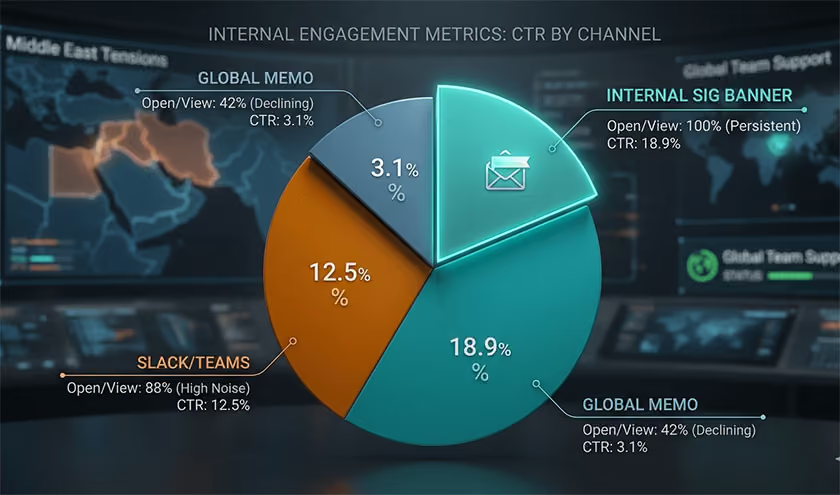
Crisis Communication Engagement Graph (Internal)
Here is the data representation of how internal signature banners perform compared to traditional newsletters during a 30-day crisis period:
Strategy III: Real-Time Operational Updates
As situations in the Middle East evolve, logistics can change in an instant. For global teams, this might mean office closures, travel restrictions, or shifted meeting hours. Instead of sending five emails a day to update the status of a regional hub, organizations can use a "Live Status" line in the signature.
Imagine a signature that dynamically updates to show:
- Office Status: [Riyadh Office - Remote Only Today]
- Travel Advisory: [All non-essential travel to Zone B suspended]
- Support: [Join the 4 PM 'Global Unity' Check-in Call Here]
This turns the email footer into a real-time dashboard. This isn't just about cool tech; it's about managing global office signatures effectively so that no employee is left in the dark during a fast-moving crisis.
Strategy IV: Accessibility and Language during Tension
In times of regional conflict, language matters. A phrase that is common in one culture might be perceived as insensitive in another. Centralized signature control allows HR to provide "Sensitivity Shortcuts"—small links in the signature that lead to "Inclusive Communication Guides."
Furthermore, ensuring these signatures are accessible across all devices is a "Duty of Care" issue. If an employee is checking their email on a mobile device while in a transit zone or a low-connectivity area, the signature must be lightweight and readable. Utilizing advanced HTML signature techniques ensures that the "Emergency Contact" link works perfectly on an iPhone in a basement just as well as it does on a desktop in a boardroom.
Compliance and Legal Disclaimers in Conflict Zones
There is also a legal dimension to communicating during Middle East tensions. Sanctions, export controls, and local regulations can change overnight. A signature that was legally compliant on Monday might be a liability by Friday.
A centralized system allows the Legal Department to update disclaimers globally in seconds. Whether it’s adding specific "Regulatory Disclosures" for regional transactions or updating HIPAA and privacy-compliant footers for medical relief teams on the ground, the ability to pivot instantly is non-negotiable.
The Human Side: "Checking In"
Finally, the most impactful use of an internal signature during a crisis is the "Check-In" button. High-performing organizations have started using simple, one-click sentiment trackers in their internal footers: "How are you feeling today? [Green/Yellow/Red]".
This allows HR to gather anonymous, real-time data on the "temperature" of the global team. If the "Red" clicks spike in a specific regional office, leadership knows to deploy mental health resources to that team immediately. This is the ultimate evolution of the psychology of the email signature—moving it from a marketing tool to a pulse-check for human welfare.
Conclusion: Engineering Empathy at Scale
Communicating during Middle East tensions requires more than just "thoughts and prayers" from the executive suite. It requires a robust, technical infrastructure that supports employees where they live: in their inboxes. By transforming the internal email signature from a static block of text into a dynamic, empathetic, and protective tool, organizations can bridge the gap between their global offices and their most vulnerable team members.
In times of uncertainty, consistency is the greatest comfort. Crossware365 empowers enterprises to maintain that consistency, ensuring that every email sent—whether it’s a routine project update or a critical safety alert—carries the full weight of the company's support, security, and global identity. Through server-side management and conditional logic, Crossware ensures that while the world may be in flux, your "Duty of Care" remains unshakeable.