Why Email Signatures Outlast Social Media Campaigns
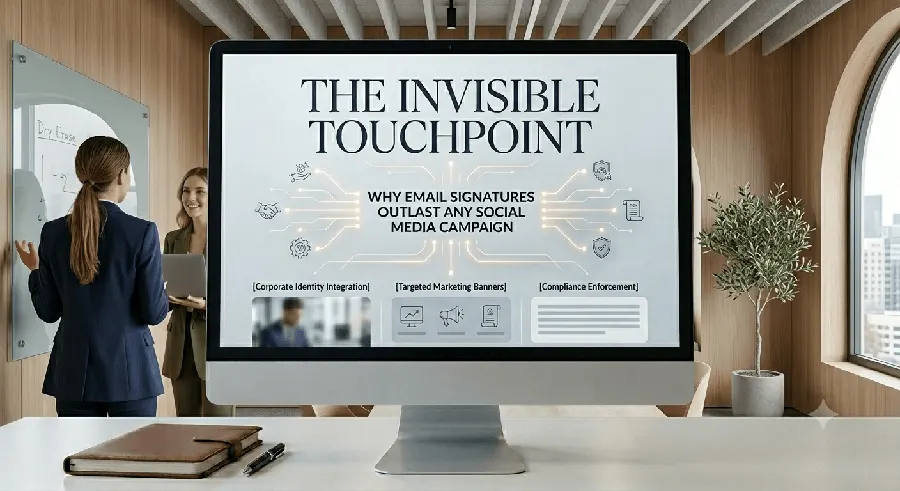
Millions of dollars are funneled into creative agencies, short-form video production, and hyper-targeted paid social media campaigns. CMOs meticulously track shifting algorithms on LinkedIn, Meta, and X, hoping to capture a fleeting sliver of their target market’s attention span. Yet, while brands chase viral moments on rented digital land, their most valuable, high-frequency, and trusted communication channel remains largely ignored: the everyday corporate email.
Every single day, your employees send thousands of direct, one-to-one communications to clients, partners, and high-value prospects. Nestled at the bottom of these critical exchanges is the "invisible touchpoint"—the corporate email signature. For large-scale enterprises looking to secure absolute brand uniformity and convert everyday correspondence into high-yielding marketing channels, centralized solutions like Crossware365 have shifted the paradigm, ensuring that every email leaving the organization is a perfectly branded, compliant, and dynamic asset.
The Transience of Social Media vs. The Permanence of the Inbox
The fundamental flaw of any social media campaign is its hyper-transience. A premium, high-production corporate post on LinkedIn has an organic half-life of roughly 24 hours before it is buried forever beneath an avalanche of fresh content. Paid social ads suffer an even harsher fate, immediately inducing banner blindness or being bypassed by users scrolling through their feeds. Social media platforms are built around distraction; your brand’s message is positioned alongside competitors, personal updates, and breaking news.
An email, by contrast, commands a completely different psychological environment. When an executive opens a direct message from a partner or vendor, that email occupies 100% of their immediate digital screen space. It does not disappear in 24 hours; it lives within a searchable, archived inbox, frequently referenced over weeks, months, or even years. When your signature block contains interactive marketing assets, its visibility remains intact for the entire lifecycle of that business relationship. Relying on social algorithms means operating at the whim of third-party platforms, whereas capitalizing on your own email flow means owning the real estate completely.
The Psychology of the Footer: Trust and First Impressions
In enterprise business-to-business (B2B) relationships, trust is the primary currency. Social media handles, while useful for top-of-funnel brand awareness, lack the gravitas required for multi-million dollar decision-making. The email signature serves as a digital handshake—a subtle, structural cue that verifies a sender’s legitimacy, corporate status, and professional standards.
When a large brand suffers from decentralized signature management, employees often design their own footers, leading to a chaotic blend of mismatched fonts, low-resolution logos, and outdated slogans. This fragmentation actively erodes trust. Psychologically, human brains look for patterns and consistency to verify safety and legitimacy.
A beautifully unified, legally compliant signature block immediately conveys that an organization is organized, disciplined, and premium. Crafting a meticulous corporate footer is rooted deeply in the email signature templates, silently communicating stability long before the recipient even reads the text of the message. This subconscious building of authority is impossible to replicate via a sponsored social media graphic.
The Volume Advantage: Massive Scale on Existing Infrastructure
For a major corporation with 10,000 employees, the sheer volume of outbound emails is staggering. If each employee sends an average of 35 external emails per day, the organization generates 350,000 direct, high-intent touchpoints every single business day. Over a single year, this amounts to over 90 million impressions.
To achieve 90 million impressions on a platform like LinkedIn or Meta, a marketing department must allocate hundreds of thousands of dollars in paid ad spend. Furthermore, those social media impressions are largely cold or semi-targeted. Email impressions, conversely, are warm, contextualized, and delivered during active business discussions. Your corporate email footer acts as a highly efficient company branding opportunity, running continuously on digital infrastructure that the enterprise has already paid for.
To visualize this disparity in value, consider the following performance comparison between a standard enterprise email ecosystem and a premium paid social media campaign:
Advanced Dynamic Marketing: Transforming the Footer
Modern enterprise email signature strategies have evolved far beyond static name, title, and phone number strings. By utilizing intelligent signature management platforms, marketing teams can segment signatures by department, region, or recipient domain to run highly sophisticated, programmatic campaigns.
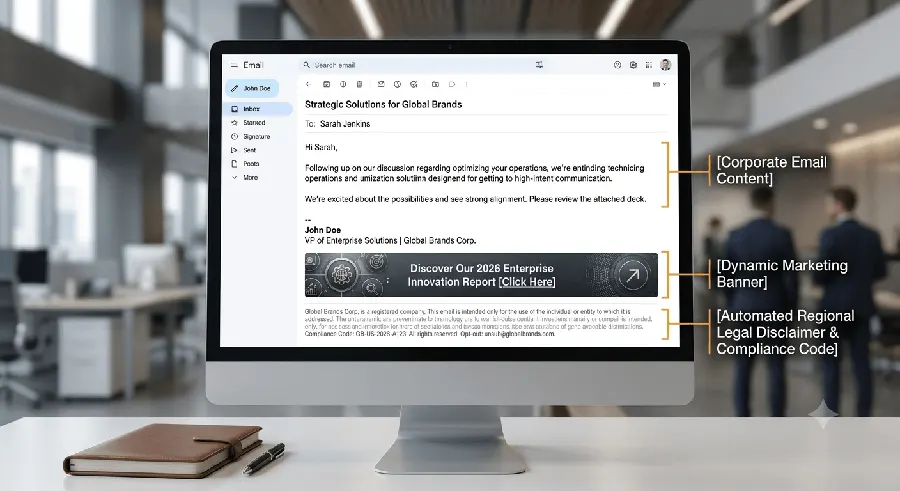
For instance, while the customer success team’s signatures can display a banner linking to the company’s latest product documentation or feature release notes, the sales team’s signatures can dynamically feature a call-to-action for an upcoming industry webinar. Marketing teams can schedule timed banners that automatically activate and deactivate alongside seasonal promotions or corporate events, entirely eliminating the need for manual employee updates.
Furthermore, smart signature management addresses communication clutter. Implementing a system that differentiates between an initial email and an active reply chain allows organizations to deploy a cleaner, condensed signature layout for replies. This preserves valuable inbox real estate and prevents long threads from becoming clogged with repetitive graphic banners and dense legal blocks, significantly streamlining ongoing client communications.
The Enterprise Shield: Compliance, Security, and Brand Continuity
For global organizations, an email signature is not merely a marketing tool; it is a legal necessity. Depending on the jurisdiction of both the sender and the recipient, corporate emails must often legally contain specific company registration numbers, registered office addresses, and structured legal disclaimers to comply with international mandates such as the EU's GDPR or US healthcare frameworks. Failing to enforce these disclosures uniformly can result in catastrophic regulatory fines.
Simultaneously, enterprise IT infrastructure faces massive technical hurdles in maintaining brand continuity across a fragmented array of user devices and display settings. A signature that looks flawless on a desktop Outlook client can completely fragment when viewed on a mobile device, or become entirely invisible when translated into a recipient's Dark Mode settings.
Enterprise branding faces an even greater threat during volatile corporate transitions. Amidst complex corporate changes, maintaining a unified corporate front is critical. If thousands of legacy employees continue to send emails utilizing retired brand assets, old logos, or inaccurate corporate entities, it causes immediate confusion in the marketplace. Centralizing this architecture ensures that brand changes are applied instantly across the entire global directory, protecting equity and mitigating compliance risks from a single dashboard.
Internal Transformation: Mitigating Digital Fatigue
While external marketing and compliance are paramount, enterprise communication strategies must also look inward. Large brands are currently battling unprecedented internal hurdles, notably a phenomenon known as "Slack fatigue" or digital tool burnout. As internal communication platforms become noisier, critical corporate announcements, HR updates, and cultural initiatives are routinely ignored by over-stimulated workforces.
Forward-thinking organizations are bypassing chaotic chat rooms by transforming internal email footers into micro-communication channels. Because employees must read internal emails to execute their daily tasks, appending clean, localized notices to internal communications guarantees eyes on internal messaging. This approach serves as an innovative internal culture builder, enabling HR and leadership teams to promote open enrollment, celebrate corporate milestones, or share safety training updates organically without adding to employee platform fatigue.
Securing the Enterprise Narrative
Social media campaigns will always have a place in a balanced corporate marketing stack for top-of-funnel reach and brand awareness. However, relying on them as the primary driver of corporate identity and ongoing engagement is a risky strategy built on rented space and unpredictable algorithms. The enterprise email signature represents an unexploited, high-yield digital asset that operates directly within the core of your B2B relationships, delivering unparalleled impressions, deep structural trust, and reliable marketing conversions day after day.
Maximizing this asset requires moving away from manual configuration and embracing centralized automation. By integrating a dedicated enterprise solution like Crossware365, large-branded companies can rest assured that every single email sent across the globe—from any device, by any department—is an absolute reflection of their premium brand standards, fully compliant with international law, and optimized to drive measurable business growth well into the future.