Email Signatures for Subsidiaries & Franchises

Running a business with multiple subsidiaries, franchise locations, or regional entities is complicated enough without adding email signature management to the list of things that can go wrong. And yet, for most multi-entity organisations, it does go wrong — quietly, persistently, and in front of every client, partner, and prospect who receives an email from anyone in the group.
The core tension is this: each entity in your group has its own identity — its own name, its own region, sometimes its own legal obligations. However, they all share a parent brand that needs to look and feel consistent. Balancing those two realities through email signatures is harder than it looks. Left to individual employees or local IT teams, the result is always the same: a sprawl of mismatched signatures that collectively undermine the credibility of the whole group.
This is not a fringe problem. A written guide on why global brands are rethinking their email signature strategy makes clear that the organisations paying the highest price for signature inconsistency are almost always the ones that grew fast. They grow through acquisitions, franchise expansion, or rapid international rollout — without ever putting a governance structure in place to keep communications aligned.
The Multi-Entity Brand Problem Nobody Talks About
Think about what happens inside a franchise group on any given Monday morning. A franchisee in Brisbane sends a proposal using a signature they built themselves in Outlook two years ago — complete with an outdated logo, the wrong brand colours, and a personal mobile number. Meanwhile, a regional director at the same group's Singapore office sends the same client a follow-up using a beautifully formatted signature from the latest corporate template. From the client's perspective, those two people appear to work for entirely different organisations.
That kind of fragmentation erodes trust in ways that are difficult to measure but very easy to feel. Clients pick up on inconsistency. It makes a business look disorganised, even when everything else about the operation is tight. And the larger the network — the more subsidiaries, the more franchise locations, the more international offices — the worse the problem gets.
The frustrating part is that it is entirely avoidable. The hidden branding power of email signatures is significant — but only when every person in the organisation is actually using the right one. In a multi-entity environment, that requires more than a shared template and a hope that people will comply.
Three Models Multi-Entity Organisations Actually Use (And Why Two of Them Fail)
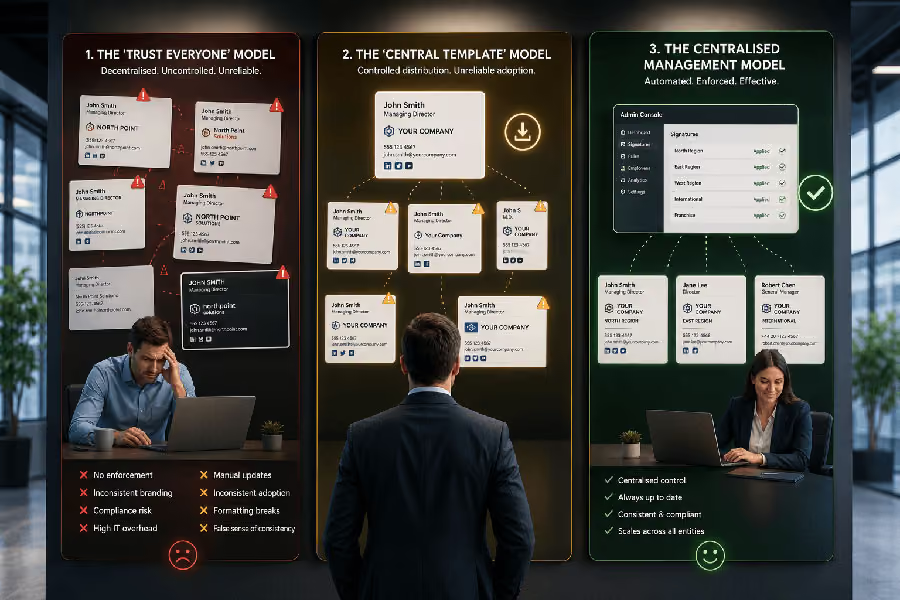
When it comes to managing signatures across a group structure, organisations tend to fall into one of three approaches.
The 'Trust Everyone' Model
This is where most organisations start and, unfortunately, where many stay. Each subsidiary or franchise location is responsible for managing its own signatures. Corporate might send out a template once a year, but there is no enforcement mechanism, no audit process, and no way of knowing what is actually going out the door. Compliance is effectively optional, and over time, entropy takes over. This model is cheap to run until you factor in the brand damage, the compliance exposure, and the IT overhead of chasing individual users.
The 'Central Template' Model
A step up from the free-for-all, but still fundamentally broken. Corporate IT designs a signature template and distributes it to everyone — usually via email, sometimes via an internal portal. Employees are expected to copy it into their email client and keep it up to date. The problems here are well documented: people customise templates, forget to apply updates, or use different devices where the formatting breaks entirely. You end up with the illusion of consistency rather than the reality of it.
The Centralised Management Model
This is the only approach that actually works at scale. A centralised platform manages all signatures across all entities from a single admin console, applying the right template to the right employee automatically based on rules tied to their directory profile. No manual steps, no employee discretion, no formatting drift. A deep dive into how to create, control and implement company-wide email signatures outlines, the shift from distribution to deployment. It separates organisations that have genuinely solved this problem from those still managing it manually.
What 'One Brand' Actually Means Across Multiple Entities
Here is where the real complexity lives. A multi-entity organisation is not a single company with a single set of employees. It is a collection of entities that may have different names, different legal structures, different regulatory environments, and different audiences — all under a shared group identity. Your signature governance strategy has to accommodate all of that without either homogenising everything into a single rigid template or allowing so much local variation that the group brand becomes meaningless.
The way to thread this needle is through structured flexibility: a common brand framework applied at the parent level — logo, typography, colour palette, legal disclaimer structure. It gives controlled variables at the entity level that allow for local names, local contact details, local regulatory disclosures, and local language where required.
✦ Pro Tip: Before building your signature templates, map out every entity in your group and list the variables that legitimately differ between them: legal name, trading name, address, phone format, regulatory body, language, and disclaimer text. These become your template variables — everything else should be locked and controlled at the group level.
The Brand Elements That Should Never Change
- Group logo and approved entity logos: Every signature should use the current, approved logo file — pulled from a central asset library, not uploaded by individual employees.
- Typography and colour palette: Font choices and brand colours must be consistent across all entities. Even small deviations compound across thousands of emails.
- Signature layout and hierarchy: The visual structure — what information appears, in what order, at what size — should be standardised across the group to reinforce visual identity.
- Core legal disclaimer language: The group-level confidentiality and liability disclaimer should be locked and consistent, with entity-specific additions appended where required.
The Elements That Should Be Locally Controlled
- Legal entity name: Each subsidiary or franchise must use its correct registered name, not just the group trading name, especially in regulated jurisdictions.
- Local address and contact details: Physical address, local phone numbers, and regional support contacts should be drawn from the employee's directory record automatically.
- Regional disclaimers: Jurisdiction-specific regulatory disclosures — financial services, healthcare, legal practices — must be applied at the entity or department level.
- Language localisation: In multilingual markets, signature content should be rendered in the appropriate local language without requiring manual input from employees.
The Franchise-Specific Challenge: Autonomy vs Brand Control
Franchise networks present a uniquely difficult version of this problem. Franchisees are independent business owners — they have their own staff, their own culture, and their own strong opinions about how they run their operation. Telling a franchisee what their email signature must look like can feel like overreach, and the pushback is real.
But the brand is the product. In a franchise model, customers are buying into the group's reputation as much as any individual location's service. An inconsistent email signature is the digital equivalent of a franchisee repainting their store in the wrong colours. It dilutes the very thing that gives the franchise its value. The most effective franchise networks make this case clearly to their operators, and then back it up with technology that makes compliance effortless rather than burdensome.
The goal is to remove friction from the right behaviour. When a franchisee's new employee joins and their signature is automatically generated from the central platform — correctly branded, correctly formatted, with the right local details — compliance happens without anyone having to think about it. This connects directly to the principle of centralised email signature management for remote teams: the further a team is from headquarters, the more important it is that brand standards are enforced automatically rather than voluntarily.
✦ Pro Tip: For franchise networks, frame signature governance as a brand asset protection policy — not an IT mandate. Present it alongside your other brand standards: signage, uniforms, packaging. When franchisees understand that the signature is part of the brand they have licensed, compliance becomes a matter of agreement rather than persuasion.
Technical Considerations for Multi-Entity Deployment
Getting signature management right across a complex group structure requires more than choosing the right platform. It requires thinking carefully about how your directory data is structured, how your email environments are configured, and what your rollout sequence looks like.
Directory Integration Is Everything
In a multi-entity environment, your employee directory — whether that is Azure Active Directory, Google Workspace, or an on-premise setup — is the source of truth for signature data. Every field that appears in a signature: name, title, department, location, phone number, entity name, needs to be accurate and consistently structured across every entity in your group. If your directory is a mess — inconsistent job titles, missing fields, entities listed differently across subsidiaries — your signatures will reflect that mess. Our guide on how to avoid brand inconsistencies across your marketing stack notes that the email signature is often the first place that upstream data quality problems become visible — and the most public place for them to show up.
✦ Pro Tip: Audit your directory data before deploying a signature platform across your group. Pay particular attention to department naming conventions, entity identifiers, and job title formats — these are the fields most likely to be inconsistent across subsidiaries and franchises, and they are the ones that drive your signature rules.
Email Environment Complexity
Multi-entity groups rarely run a single clean email environment. You might have the parent company on Microsoft 365, a recently acquired subsidiary still running on Google Workspace, and a franchise network where some operators have not migrated from legacy Exchange. Each environment needs to be accounted for in your signature strategy — and the platform you choose needs to handle all of them without requiring separate management workflows for each.
Rollout Sequencing
Do not try to roll everything out at once. Start with the entities that have the highest client visibility — your largest subsidiary, your flagship franchise locations, your senior leadership team. Get those right, document what worked, and then expand. A phased rollout also gives you time to identify data quality issues in your directory before they surface in front of external contacts.
Keeping It Current: The Ongoing Management Challenge
Deploying a signature solution is the beginning of the work, not the end of it. Multi-entity organisations are in constant motion — new acquisitions, new franchise locations, rebrands, leadership changes, regulatory updates. Each one has implications for your signatures, and each one needs to be managed without disrupting the hundreds or thousands of employees who are sending emails every day.
The organisations that manage this well treat email signatures as a living brand asset — something that requires the same care and governance as any other piece of corporate communications. They assign ownership, build update workflows, and connect their signature platform to their HR and directory systems so that changes cascade automatically. For marketing teams in particular, the ability to maximise the email signature's endpoint as a marketing asset means keeping templates fresh — rotating campaign banners, updating CTAs, reflecting seasonal priorities — across every entity in the group simultaneously.
When a new subsidiary is onboarded, their signature templates should be configured before the first employee sends their first email — not six months later when a client notices the old branding. When a franchise network runs a group-wide campaign, every franchisee's outgoing emails should carry the campaign banner automatically, without requiring any action from individual operators. That level of coordination is only possible with centralised management.
One Brand Is a Decision, Not a Default
Multi-entity organisations do not accidentally achieve brand consistency. It is the result of deliberate decisions: about governance structures, about technology platforms, about how much flexibility is extended to local entities and how much is retained at the centre. Email signatures are a small but surprisingly revealing test of whether those decisions have actually been implemented.
When a client receives ten emails from ten different people across your group and every single one looks like it comes from the same professional, well-organised organisation, that is not an accident. It is the product of a governance model that takes brand consistency seriously enough to enforce it at the infrastructure level — not just in the brand guidelines document that no one reads.
The technology to do this well exists and is more accessible than most multi-entity organisations realise. The harder work — aligning stakeholders, cleaning up directory data, getting franchise operators on board — is organisational, not technical. But it is worth doing. Because in a competitive market, the brands that feel consistent earn more trust. And trust, in the end, is what the whole exercise is about.
If your group is ready to bring genuine consistency to every email sent across your entire network — subsidiaries, franchises, and everything in between — visit Crossware365 to explore how our services help multi-entity organisations turn email signatures from a brand liability into a brand asset.