How to Map Your Email Signature to the Buyer Journey

Large-branded companies spend millions of dollars fine-tuning their automated email drip campaigns, landing pages, and account-based marketing (ABM) workflows to ensure that the right message reaches the right stakeholder at exactly the correct moment. Yet, an enormous blind spot persists within these carefully engineered funnels. Every day, across global directories, enterprise employees send millions of un-optimized, static, 1-to-1 emails directly to high-intent targets.
When a corporate email footer is left unmanaged or treated as mere administrative text, a massive pipeline opportunity is wasted. Instead of serving as a dead-end block of text, the modern email signature must be treated as a fluid, dynamic marketing conduit. To unlock its full potential, enterprise organizations must move away from static templates and actively map their corporate email signatures directly to the corresponding stages of the buyer journey.
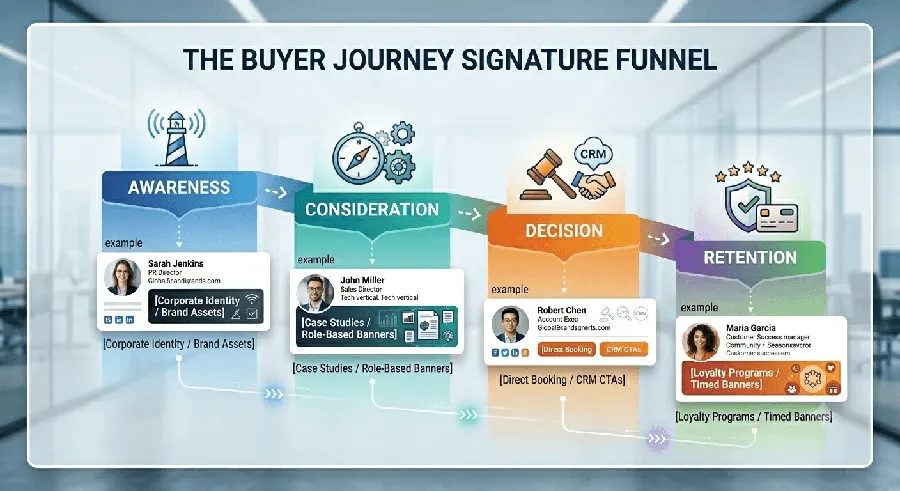
1. The Awareness Stage: Building Subconscious Authority
At the top of the funnel, prospects are discovering your brand for the first time. They are inherently skeptical, looking to verify your organization’s scale, professionalism, and legitimacy. At this stage, your email signature functions as a primary digital handshake. If a sales executive or account team reaches out to a new prospect with an inconsistent, poorly formatted, or broken signature graphic, it introduces immediate friction.
For top-of-funnel interactions, the email signature must focus entirely on baseline authority, structural balance, and frictionless validation. The signature layout should display pristine corporate asset styling that mirrors your enterprise website. It is critical to establish a polished appearance from the very first interaction, using the science of digital first impressions to quietly communicate security and operational scale before the recipient even responds to the initial pitch. Banners at this stage should remain educational and low-pressure, linking directly to high-level industry reports, company-vetted blogs, or overarching brand stories.
2. The Consideration Stage: Proving Competency Through Context
Once a prospect transitions into the consideration phase, their informational needs change dramatically. They understand who your brand is; now, they are actively evaluating your capabilities against global competitors. A broad, generalized corporate signature banner promoting a generic homepage will no longer suffice. Marketing departments must leverage department-based or role-based directory routing to inject hyper-targeted, context-driven content into active threads.
During the consideration stage, signatures must deliver specific proofs tailored to what the recipient cares about most. This requires segmenting signature blocks across different corporate departments to display unique assets that move the deal forward. The following table illustrates how a large organization can segment its footers to match the specific needs of mid-funnel buyers:
By ensuring that your team's communications are embedded with highly contextual proofs, your email footers become an organic extension of your active marketing campaign. Delivering these assets inside regular business correspondence allows brands to seamlessly turn every email into a branding opportunity that reinforces product capability without adding to the prospect's email fatigue.
3. The Decision Stage: Removing Friction at the Bottom of the Funnel
At the bottom of the funnel, the client is on the precipice of a final purchasing decision. Proposals are being evaluated, legal parameters are being negotiated, and procurement protocols are underway. At this critical juncture, your marketing assets must shift from educational to transactional. The goal here is simple: eliminate administrative roadblocks and make it as easy as possible for the buyer to finalize the deal.
Signatures mapped to the decision stage should utilize direct action-oriented features, such as integrated calendar booking widgets, secure contract review portal hyperlinks, or immediate contact lines. Furthermore, because decision-stage negotiations often result in sprawling, multi-party reply threads, it is essential to adjust the layout to keep the conversation clean.
- Implement Condensed Layouts: Deploying a streamlined format for ongoing discussions ensures that legal disclaimers and large promotional banners do not overwhelm the message thread.
- Remove Message Clutter: Utilizing cleaner, condensed signature layouts for replies helps preserve screen real estate, keeping the focus entirely on contract negotiations while maintaining a crisp, professional presentation.
- Prioritize Conversion Architecture: Structuring templates with concise, high-visibility contact strings is a proven method for improving your sales strategy, removing structural friction during late-stage deal finalization.
4. The Post-Purchase Retention & Expansion Stage: Maximizing Lifetime Value
The buyer journey does not terminate once a contract is signed. For modern enterprise organizations, building long-term customer relationships and identifying account expansion opportunities are crucial for sustaining revenue growth. Once a client is onboarded, their main day-to-day contacts shift from sales executives to customer success managers, technical support teams, and account directors.
Email signatures sent from these departments should be dynamically mapped to maximize customer lifetime value (LTV). When a customer success manager sends a weekly status update, the signature footer can automatically rotate banners to highlight upcoming customer training webinars, newly released feature updates, or user community events. This keeps the client continually engaged with your ecosystem.
Designing interactive, helpful elements within post-purchase footers acts as an organic catalyst for boosting long-term customer loyalty, subtly reminding the client of your ongoing value without the need for intrusive marketing pitches. Marketing teams can also deploy scheduled timed banners for promotional events, ensuring that current customers are automatically made aware of seasonal loyalty discounts or regional user conferences.
The Internal Funnel - Culture and Employee Alignment
An often overlooked component of the corporate ecosystem is the internal buyer journey—specifically, the internal alignment of your global workforce. If employees are not aligned with your brand's core values, product releases, and corporate initiatives, they cannot effectively guide external prospects through the customer acquisition pipeline.
Enterprise organizations are continuously searching for creative strategies to cut through internal noise and ensure that vital corporate announcements are actually absorbed. By turning internal email footers into micro-communication channels, HR and internal marketing teams can display tailored corporate notices, employee compliance deadlines, and internal milestones directly within everyday peer-to-peer correspondence. This targeted strategy provides an innovative internal culture builder that guarantees visibility on company news without compounding internal platform fatigue.
To maximize the impact of both internal and external campaigns, organizations must continuously audit their performance data. Marketing teams should leverage advanced tracking frameworks to actively monitor click-through rates (CTR) across all active signature banners. Analyzing this engagement data allows companies to see exactly how prospects react at every touchpoint, giving them the insights needed to refine their messaging and optimize the funnel in real time.
Strategic Funnel Architecture
Orchestrating a journey-aware email signature architecture across a massive enterprise directory requires a shift from manual user settings to a completely centralized, server-side management engine. When a signature strategy is managed at the individual level, compliance gaps emerge, brand styling fragments across different devices, and running synchronized, multi-tiered marketing campaigns becomes functionally impossible.
For large-scale global brands looking to master journey-mapped email correspondence, Crossware365 provides the definitive enterprise-grade orchestration engine. Operating natively within Microsoft 365, Google Workspace, and hybrid cloud environments, Crossware gives marketing and IT teams absolute central control over corporate footers.
The platform’s advanced dynamic rule builder allows enterprises to automatically inject hyper-targeted marketing banners, department-specific branding assets, and compliant legal disclaimers based on the sender, recipient domain, or active date windows. By centralizing this infrastructure, Crossware transforms everyday corporate email traffic into a fully automated, journey-aligned marketing machine that drives pipeline velocity, protects enterprise brand equity, and unlocks hidden revenue with every single click.