How Global Teams Localize Without Losing Brand Control

For Chief Marketing Officers and IT Directors, this dilemma creates a painful trade-off: Do you enforce rigid global standardization at the cost of regional resonance, or do you grant local autonomy and watch your brand equity dilute? Achieving global consistency does not require sacrificing local connection. By implementing strategic governance over digital footers, global organizations can deliver localized communications that build immediate trust while preserving absolute brand control and building cohesive professional branding.
When enterprise companies expand across borders, corporate communication undergoes a dramatic shift. Entering new international markets demands more than simply translating website copy or localized ad campaigns; it requires every touchpoint to feel native, culturally aligned, and personally relevant. Yet, amidst massive multi-market expansions, executive leadership often overlooks the corporate email signature, the single most frequent business communication channel in existence.
Without systematic oversight, this high-volume channel quickly degenerates into a chaotic free-for-all. Local teams attempt to adapt sign-offs on their own, resulting in stretched logos, outdated regional promotions, inaccurate contact details, or missing legal disclaimers.
The Global Localization Paradox: Cultural Connection vs. Central Governance
Managing a global enterprise brand requires navigating a delicate balance. On one hand, central marketing leadership spends millions creating unified brand standards—specifying precise hex codes, typography hierarchy, logo usage guidelines, and core messaging tone. On the other hand, regional sales and account management teams in Tokyo, Frankfurt, or São Paulo know that generic, English-only communications fail to resonate with local buyers who expect communication in their native language, formatted to local cultural norms.
Enterprise Research Insight: Brand Dilution vs. Regional Engagement
Global organizations face a double-edged challenge when communications are left unmanaged at the regional level:
- Brand Dilution at Scale: When decentralized offices modify email sign-offs without central oversight, organizations experience severe visual fragmentation, outdated messaging, and increased legal compliance exposure.
- Elevated Buyer Engagement: Conversely, when global sales teams deploy signatures tailored to local norms—featuring native titles, direct regional contact numbers, and local regulatory disclosures—they achieve significantly higher response rates compared to generic, one-size-fits-all English signatures.
When global organizations lack structured control, local offices inevitably take matters into their own hands. A branch manager in Germany might add a massive, non-compliant legal notice in German. A regional sales rep in Brazil might swap the corporate logo for a low-resolution promotional graphic. An account director in France might manually translate their job title using phrasing that sounds unnatural to local clients.
This friction highlights the primary challenge of localizing email footprints across international branches. Decentralized customization introduces severe visual inconsistencies and exposes the company to legal vulnerabilities. European privacy regulations like GDPR, along with regional commercial disclosure laws across various jurisdictions, carry strict requirements regarding mandatory company registration numbers, tax IDs, and privacy policy disclosures. Failing to enforce correct regional regulatory disclaimers and compliance standards inside daily correspondence leaves international enterprises vulnerable to hefty financial penalties and reputational harm.
Aligning Localized Signatures with the Enterprise Buyer’s Journey
To transform email footers from a passive liability into an active revenue driver, enterprise teams must view localized email sign-offs through the lens of the buyer’s journey. Different stages of customer acquisition and retention require distinct messaging, visual hierarchy, and calls to action.
By tailoring signature content for distinct audience segments, marketing and sales leaders can guide international prospects through the funnel effortlessly, turning every daily email into a high-value marketing channel.
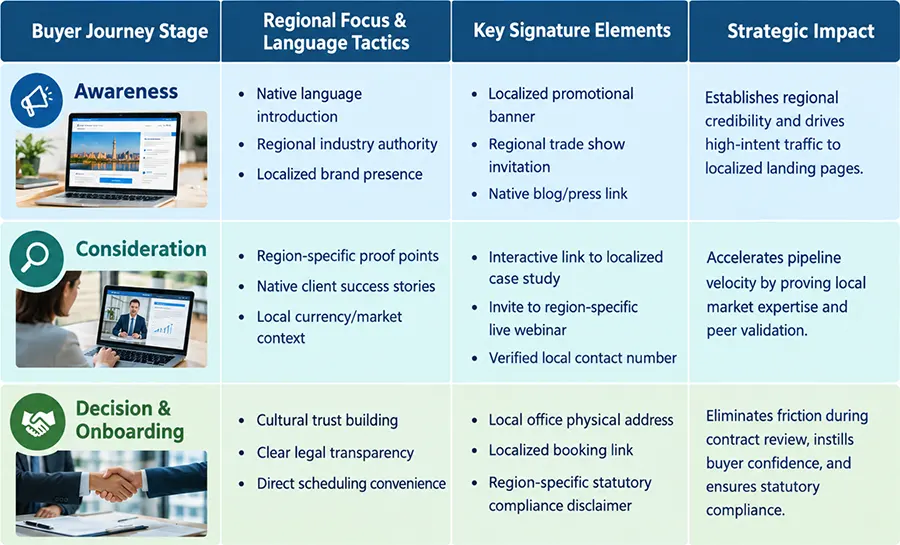
1. Awareness Stage: Driving Local Discovery
When regional reps outreach to cold or early-stage prospects, the signature block serves as an immediate trust indicator. Displaying the employee’s name and job title in the primary local language alongside a secondary international translation reassures the recipient. A dynamic banner announcing an upcoming regional industry trade show or linking to a newly translated whitepaper turns routine sales outreach into an engine for brand discovery.
2. Consideration Stage: Nurturing Regional Engagement
During contract evaluation or technical discovery, international buyers look for proof that an enterprise can support their specific geographic needs. Signatures updated with links to localized video testimonials, native language case studies, or regional customer success stories validate product capability within the buyer's home market.
3. Decision Stage: Streamlining Frictionless Conversions
As deals approach closing, simplicity and compliance take center stage. Signatures equipped with localized meeting scheduling links—automatically synchronized to the rep's local time zone—remove scheduling friction. Simultaneously, embedded regional legal footers reassure enterprise procurement teams that your company complies fully with local regulatory mandates.
Bridging the IT and Marketing Divide: Governance Without Friction
Historically, localized email signature projects stalled due to internal departmental friction. Marketing teams wanted dynamic, visually rich promotional banners and creative campaign flexibility. IT departments demanded strict directory security, minimal administrative workload, and zero end-user intervention.
When signature updates rely on individual employees pasting HTML snippet codes into desktop clients, chaos is guaranteed. Employees accidentally distort layout tables, delete tracking tags, or alter corporate colors.
Resolving this conflict requires moving away from manual desktop configurations toward an automated server-side framework. By adopting automated rules mapped to central directory data (such as Microsoft Entra ID or Google Workspace directories), global companies can effortlessly manage dynamic signatures without disrupting workflow.
By boosting targeted promotional campaign reach through automated rules, marketing departments can schedule localized banner campaigns to deploy and expire automatically across specific countries or department branches. Simultaneously, IT administrators maintain full control over security protocols while eliminating fragmented employee sign-offs entirely.
Pro Tip for Enterprise Directors
Implement "Dynamic Block Governance"
Divide signature layouts into master structural zones. Lock core corporate assets (master logo, executive typography, brand color scheme, legal disclaimers) at the global enterprise level. Then, grant regional marketing managers permission to edit localized dynamic blocks—such as regional phone numbers, native job titles, and localized promotional banners. This hybrid structure guarantees brand control while giving local teams the agility they need.
Achieving Global Brand Harmony at Scale
Global enterprise growth should never force a choice between brand integrity and local market relevance. By establishing a modern, enterprise-wide strategy for daily email communications, multinational organizations can ensure every outgoing email strengthens corporate authority, engages regional prospects, and complies with local regulations.
Achieving this level of control across thousands of seats, multiple cloud environments, and diverse global regions requires software built specifically for complex enterprise infrastructures. As a premier solution for global email signature management, Crossware delivers a centralized platform designed to solve these exact challenges. With Crossware, IT and marketing executives gain complete governance over brand assets, dynamic localization rules, and compliance disclaimers across Microsoft 365, Exchange, and Google Workspace—ensuring every message sent worldwide is perfectly branded, localized, and compliant.