Agentic AI for Email Signature Compliance
For years, email signature management has been treated as a relatively simple business task: create a template, add the company logo, include the employee's details, insert the required disclaimer, and make sure everyone uses the correct version.
For a small organization, that may be manageable.
For a global enterprise with thousands of employees, multiple offices, different business units, changing regulations, and constantly evolving marketing campaigns, it becomes much harder.
Now another shift is taking place. Agentic AI is moving beyond simply helping people create content and toward systems that can take action across business workflows. Instead of waiting for an employee to tell a system what to do, an AI agent can potentially monitor a situation, determine what needs to happen, and carry out a series of approved actions.
That raises an important question for enterprise leaders: What happens when autonomous AI workflows meet email signature compliance?
The answer is not that AI should be given unlimited control over corporate communications. Rather, agentic AI creates an opportunity to make signature management more proactive, responsive, and consistent—while keeping important decisions under human governance.
From AI Assistant to AI Workflow
The easiest way to understand agentic AI is to compare it with the AI tools many employees already use.
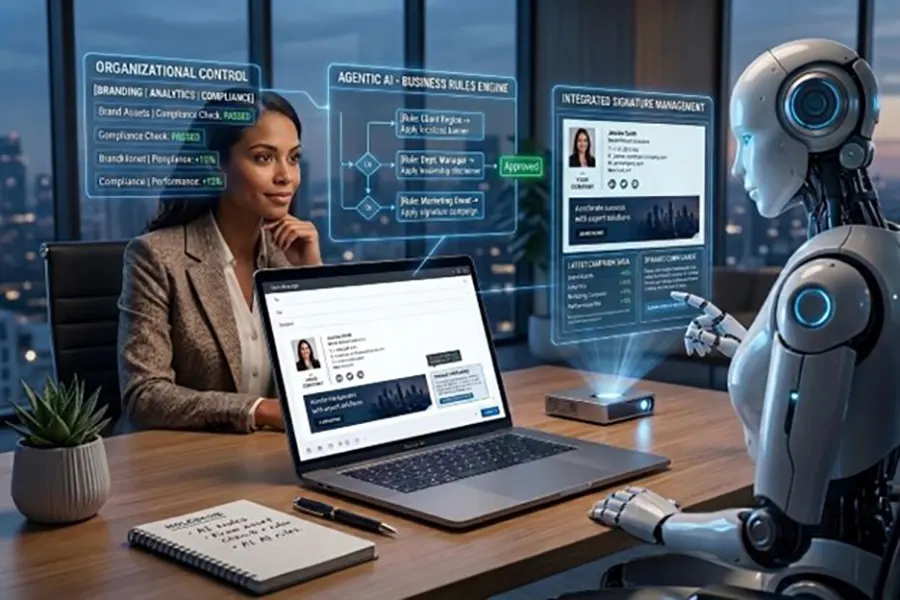
A conventional AI assistant might help an employee write an email. An agentic system goes a step further. It can potentially recognize that a task needs to be completed, gather the relevant information, make decisions according to predefined rules, and take several actions to complete the workflow.
That distinction matters for email signatures.
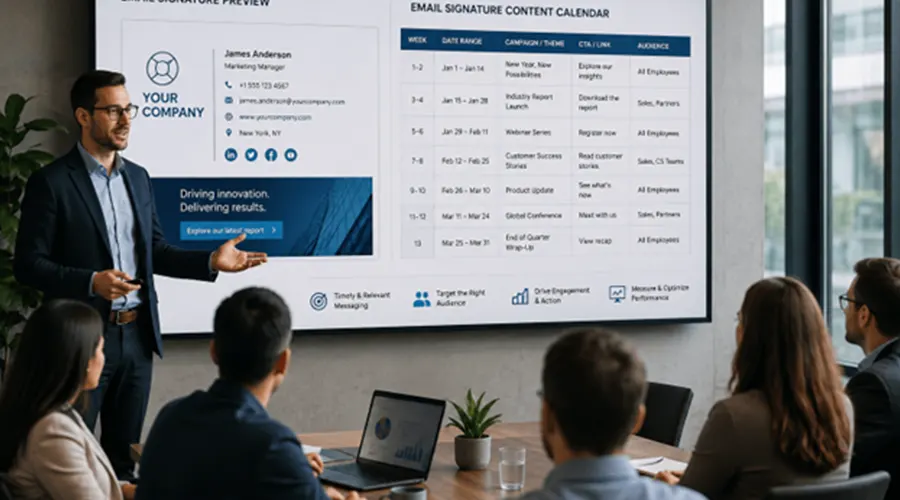
Imagine an enterprise launching a new campaign. Traditionally, marketing may need to tell IT about the campaign, provide the banner, specify which employees should use it, give a start and end date, and later remember to remove it.
An autonomous workflow could potentially monitor the approved campaign calendar, recognize that the launch date has arrived, apply the appropriate signature content to the defined audience, and remove or replace it when the campaign ends.
The human team still defines the rules. The workflow simply handles more of the repetitive execution.
This direction is becoming increasingly relevant. McKinsey's 2025 global AI survey found that 62% of respondents said their organizations were at least experimenting with AI agents, while 23% reported that their organizations were already scaling an agentic AI system somewhere in the enterprise.
The technology is still developing, but the business implication is clear: organizations are beginning to explore AI that does more than generate information.
Why Email Signatures Are a Natural Candidate for Smarter Workflows
Email signatures contain a mixture of information that changes at very different speeds.
An employee's name and job title may remain unchanged for months. A legal disclaimer may need to follow a particular regional requirement. A marketing banner might change every two weeks. A sales CTA may change depending on a campaign. A corporate announcement may need to appear across thousands of emails for only a few days.
That makes signatures a good example of a business process that contains both stable and changing information.
Research on centralized signature management shows how organizations can already bring branding, personalization, analytics, and compliance into a more controlled environment.
Agentic AI could take that idea further by helping the system determine what should happen next according to approved business rules.
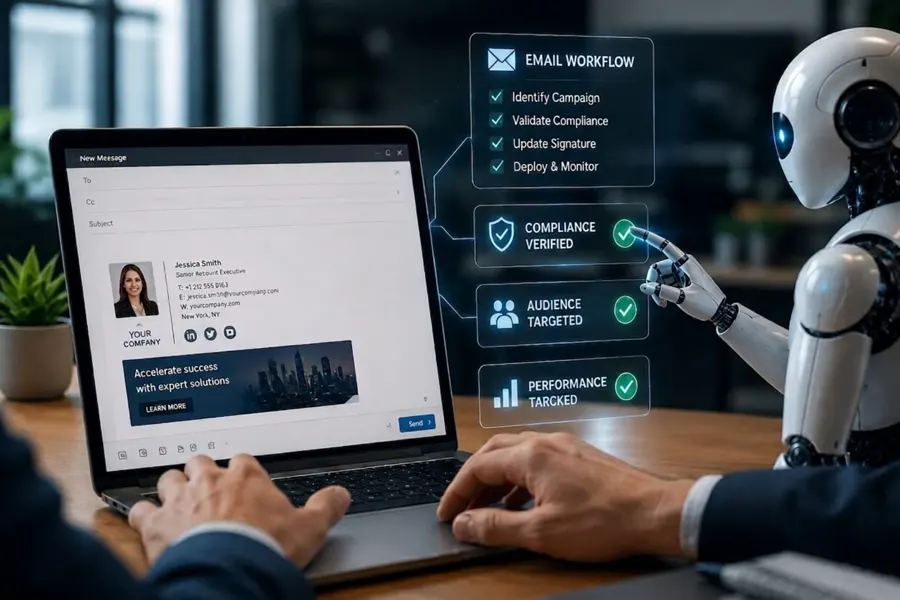
For example, an enterprise could establish rules such as:
- A new employee must receive the correct signature when they join.
- A departing employee's signature should no longer be active.
- A legal notice should appear for particular regions or business activities.
- A campaign banner should begin and end on defined dates.
- Sales employees should receive one promotional CTA while customer teams receive another.
- Outdated campaign links should be identified for review.
The important distinction is that the AI should not invent the company's policies. People establish the policies; intelligent workflows help enforce them.
The Compliance Opportunity: From Checking to Preventing
Compliance is where this becomes particularly interesting for IT directors and business leaders.
A traditional compliance approach often involves checking whether employees are following the rules. Someone discovers an outdated disclaimer, incorrect company information, or an unapproved signature and then asks the relevant team to fix it.
A smarter workflow aims to prevent the problem from occurring in the first place.
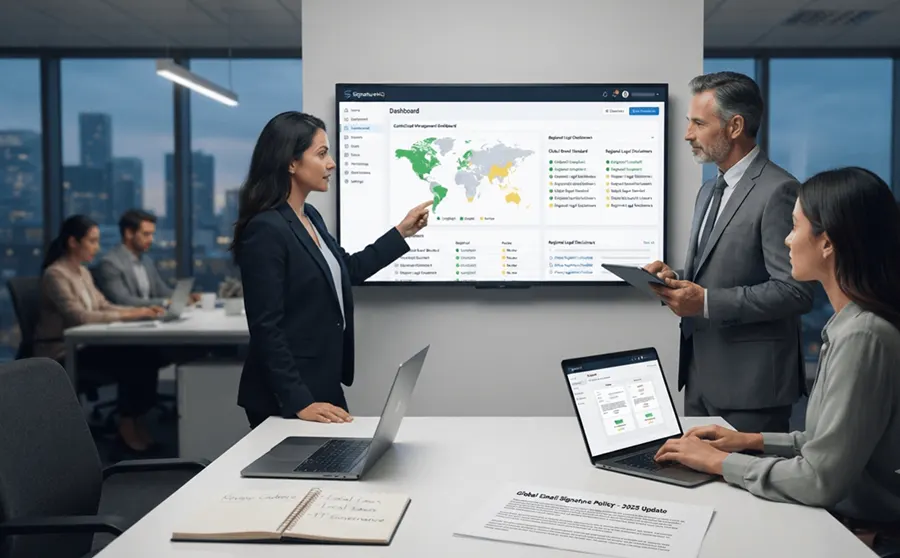
Consider a multinational organization operating across several countries. A new regulatory requirement affects the wording that must appear in certain external communications.
Instead of relying on thousands of employees to manually update their signatures, an intelligent workflow could identify which users and communications are affected, apply the approved change according to predefined rules, and provide a record for the responsible teams to review.
This is consistent with the broader direction of enterprise AI governance. Deloitte emphasizes that organizations adopting agentic AI need appropriate risk management, workforce involvement, and controlled implementation rather than simply giving autonomous systems unrestricted authority.
For email signatures, that means automation should operate inside a governance framework.
The system might recommend or execute routine changes, but legal, compliance, marketing, and IT teams should remain responsible for defining what is permitted.
The Buyer Journey Should Influence the Signature
Signature compliance should not be viewed only as a legal or IT concern. Email signatures are also part of the customer experience.
As AI-driven workflows become more capable, organizations can potentially make signature content more relevant to where the recipient is in the buyer journey.
For example, if marketing has an approved campaign for prospects in the consideration stage, an intelligent workflow could help ensure that the appropriate sales teams receive the campaign message during its active period.
This builds on the concept of personalizing signatures for different audiences, where different recipients, regions, or business groups can receive more relevant signature content.
The objective is not to make every email look different. It is to make the right part of the signature relevant while preserving the company's consistent identity.
Pro Tip: Automate the routine, not the judgment
The safest approach to autonomous signature workflows is to automate predictable tasks while keeping high-impact decisions with people.
Changing a campaign banner when its approved end date arrives is routine.
Deciding what legal wording a company should use is not.
That distinction can help enterprises gain the efficiency benefits of AI without handing critical brand or compliance decisions to an uncontrolled system.
What an Agentic Signature Workflow Could Look Like
Consider a large professional services organization preparing for an annual industry conference.
Marketing creates an approved campaign and defines the audience, dates, CTA, and destination page. IT establishes the rules governing which employees can display the campaign. Compliance approves the required wording.
An intelligent workflow could then coordinate the process.
Before the campaign begins, it checks that the necessary information is available. On the launch date, the campaign appears for the appropriate employees. During the campaign, performance information can be monitored. When the event ends, the promotional content is automatically removed or replaced with the next approved message.
The employees do not need to remember to update anything.
This concept builds on existing enterprise practices around timed promotional signature banners, where campaign content can already be scheduled around business events.
The difference is that future agentic workflows could potentially coordinate more of the surrounding process instead of simply displaying scheduled content.
Compliance Needs a Single Source of Truth
Autonomous workflows are only as reliable as the information and rules they use.
If marketing has one version of the company logo, HR has another set of employee information, and legal maintains disclaimers in a separate document, an AI system cannot magically resolve those contradictions.
That is why centralized governance becomes increasingly important as automation grows.
An enterprise needs to know which information is authoritative, who is allowed to approve changes, and which rules apply to different employees and situations.
Research on centralized management for distributed teams highlights the challenge of maintaining consistent signatures when employees work across locations, devices, and regions.
For agentic workflows, the same principle becomes even more important: one trusted source of information, clear rules, and defined responsibility.
Measure the Results, Not Just the Automation
Another advantage of smarter workflows is the ability to connect compliance with performance.
An enterprise should be able to ask more than, “Did everyone receive the new signature?”
It should also ask:
Did the campaign generate engagement? Which CTA performed best? Which audience responded? Were outdated messages removed on time? Were compliance changes applied consistently?
Signature analytics can provide insight into these questions. Guidance on using signature analytics for sales and marketing shows how clicks and engagement data can help organizations understand which signature content is producing results.
That creates a valuable feedback loop: plan, deploy, measure, learn, and improve.
The Enterprise Principle: Controlled Autonomy
The biggest mistake would be to interpret agentic AI as “let the AI run everything.”
Enterprise environments need the opposite approach: controlled autonomy.
AI can potentially monitor routine changes, identify inconsistencies, recommend actions, execute approved workflows, and flag exceptions for human review.
People should remain responsible for the policies, approvals, brand standards, legal requirements, and strategic decisions behind those workflows.
This is particularly important because agentic AI is still relatively early in its enterprise journey. McKinsey's research shows that while experimentation is widespread, most organizations have not yet scaled agents broadly across their businesses.
The opportunity, therefore, is not to rush toward complete autonomy. It is to identify practical areas where automation can remove repetitive work without compromising control.
For email signatures, those areas could include onboarding, campaign scheduling, compliance checks, information updates, audience targeting, and retirement of outdated content.
From Compliance Task to Intelligent Workflow
Email signatures may look like a small part of enterprise communication, but they sit at the intersection of brand, marketing, employee information, customer experience, and compliance.
That makes them an interesting candidate for the next generation of intelligent business workflows.
The future is unlikely to be about AI independently deciding what every employee's email should look like. It is more likely to involve people defining the rules and intelligent systems making sure those rules are consistently carried out at scale.
For IT, that can mean fewer repetitive requests. For marketing, it can mean faster campaign deployment. For compliance teams, it can mean stronger consistency and visibility. For business leaders, it can mean turning an overlooked communication channel into a more responsive part of the customer journey.
Organizations looking to bring that controlled, scalable approach to enterprise email signatures can turn to Crossware as the core solution for centralized signature management, helping businesses maintain brand consistency, support compliance, manage dynamic communications, and prepare their email environment for increasingly intelligent workflows.