Signature Drift: The Silent Brand Killer Inside Your Organization

Enterprise corporations spend millions of dollars establishing, protecting, and propagating their visual identities. CMOs deploy exhaustive design guidelines that dictate the exact pixel placement of a corporate logo, specify color palettes down to the precise Pantone value, and strictly govern typography across public-facing websites, television commercials, and print materials. Yet, while the front door of the brand is meticulously polished, a silent, chaotic fragmentation is occurring inside the digital back lines.
Every single business day, thousands of your global employees open their mail clients and send millions of direct communications to clients, suppliers, investors, and high-value prospects. Nestled at the bottom of these high-intent business interactions is a critical touchpoint that is routinely neglected by corporate governance. Left to their own devices, well-meaning employees will modify, tweak, or entirely redesign their email footers.
This organic, decentralized distortion is an administrative phenomenon known as "Signature Drift." For large-branded companies, Signature Drift is a silent brand killer that quietly erodes corporate authority, compromises cybersecurity postures, and exposes the organization to massive regulatory penalties.
The Hidden Costs of Silent Brand Erosion
In enterprise B2B relationships, trust and credibility are built through consistent, disciplined execution. Human cognitive psychology dictates that people judge organizational stability based on structural consistency. When an institutional buyer receives a contract proposal from an enterprise vendor, every element of that communication must project an unshakeable standard of excellence.
When a brand suffers from decentralized signature management, this professional illusion shatters. A recipient scrolling through an active email thread will immediately spot a patchwork of mismatched colors, broken graphics, and text sizes that fluctuate wildly from message to message. This visual inconsistency sends a subtle, damaging message to the market: if this company cannot coordinate its own internal communication footers, how can it reliably manage an enterprise-scale client contract?
A meticulously constructed signature block, by contrast, establishes a digital handshake that silently conveys institutional authority long before the recipient analyzes the core text. For large brands looking to project absolute uniformity, mastering the science of digital first impressions through absolute layout control is a non-negotiable step toward securing multi-million dollar business lines. Leaving this responsibility to the discretion of individual end-users represents an unnecessary and expensive risk to brand equity.
The Anatomy of Signature Drift: How the Chaos Begins
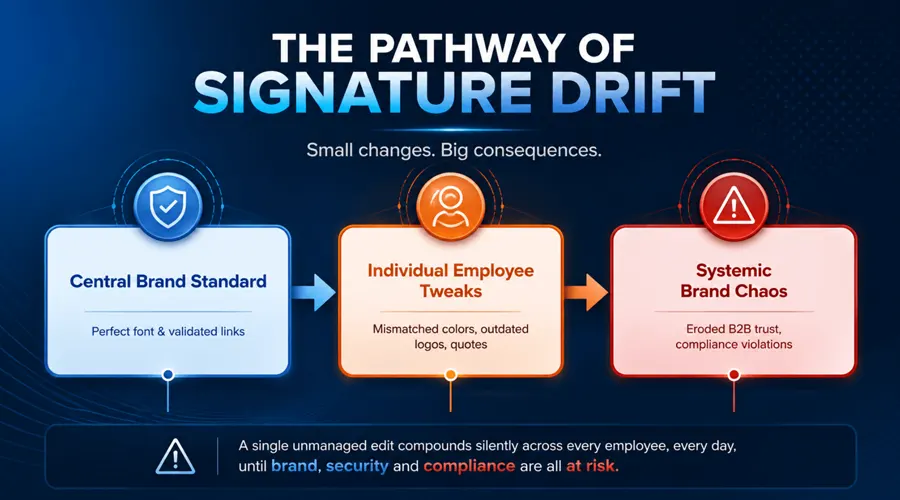
Signature Drift rarely originates from a place of malice. Instead, it is driven by a lack of centralized operational control and the natural tendency of individual employees to personalize their digital workspace. The process begins innocently: a newly hired regional sales manager notices that their email signature does not match a colleague's layout. To fix it, they manually copy and paste the footer text from an old thread into their mail application settings.
In doing so, the clean corporate font is inadvertently replaced by a non-standard device font. The compressed, crisp company logo is stretched out of proportion, resulting in a low-resolution, pixelated graphic. Over the ensuing months, other team members follow suit. Some decide to append links to their personal social channels, others choose to display motivational quotes, and many continue to feature marketing graphics for product promotions that concluded six months prior.
Within a multi-thousand-user organization, this lack of structure scales exponentially. If an enterprise with 10,000 users generates an average of 35 outbound external emails per employee daily, it creates over 90 million annual impressions. When Signature Drift goes unchecked, those 90 million interactions cease to function as a unified brand asset; instead, they transform into 90 million disparate, uncoordinated representations of the company.
Security Vulnerabilities: The IT Threat Hidden in Plain Sight
While creative directors despair over broken layouts, Chief Information Security Officers (CISOs) face a far more dangerous consequence of Signature Drift: cybersecurity compromise. Because decentralized signatures require manual user configuration, employees frequently introduce unverified hyperlinks, third-party badges, and non-secure image components into their mail settings.
These non-vetted links present an attractive vector for social engineering and spear-phishing campaigns. If an attacker compromises an employee's machine or intercepts outbound mail files, unmonitored links can be subtly redirected to malicious staging sites or credential harvesting platforms. Furthermore, because individual users lack the technical knowledge to securely configure image paths, they often link to files hosted on public, unsecured external servers. This can trigger security alerts within recipient firewalls, causing your primary corporate communication to be flagged as unsafe.
To insulate an organization against these vectors, modern IT departments must enforce strict architectural parameters. Securing these touchpoints requires implementing specific safety controls, including role-based access restrictions and encrypted transmission pathways. By establishing the top security features for email signatures—such as secure image hosting, vetted anti-phishing URLs, and authenticated domain configurations—global corporations can effectively turn a major vulnerability into an insulated operational asset.
The Regulatory Minefield: Legal Compliance Failures
For multinational enterprises, a fragmented email signature is not just a branding headache—it is a legal liability. Corporate email communications are classified as formal corporate correspondence under international law, meaning they are subject to stringent regional governance mandates.
Depending on the geographic location of both the sender and the recipient, corporate emails must legally feature specific company registry numbers, verified office addresses, and precise legal disclaimers. Under frameworks like the EU’s General Data Protection Regulation (GDPR) or US healthcare frameworks like HIPAA, failing to follow a rigorous GDPR and HIPAA compliance checklist for these required disclosures on outbound communications can lead to immediate and costly regulatory audits.
When Signature Drift takes root, critical legal parameters are inevitably stripped out by employees attempting to streamline their email layouts. Alternatively, outdated text disclaimers are left intact long after corporate entities change or regional laws shift. Large brands cannot afford to leave regulatory protection up to individual user compliance. True security requires an automated system that automatically appends the correct, location-specific legal disclaimers and compliance text based on global user directory data, removing human error from the equation entirely.
The Marketing Blind Spot: Wasted Impressions and Operational Drag
Every outbound message leaving your enterprise network is a highly targeted piece of digital media. Because these 1-to-1 interactions occur during active business discussions, their audience engagement potential far exceeds that of paid programmatic banners or display advertisements on social networks.
Signature Drift effectively paralyzes this channel. When signature configuration is decentralized, marketing teams have no way to execute coordinated, real-time campaign banners across the global directory. A department might launch a premium global initiative, yet thousands of employees will continue to send emails featuring outdated marketing collateral, dead promotional links, or broken promotional graphics. This fragmentation completely isolates the signature asset from the rest of your modern marketing stack, making it impossible to turn every email into a branding opportunity that reinforces active campaigns.
Beyond the lost marketing opportunity, the operational drag of manual signature tracking is a major drain on internal resources. When corporate identity shifts—such as during large-scale Mergers and Acquisitions—IT and HR teams are forced to waste hundreds of hours drafting instruction manuals, building step-by-step videos, and conducting individual user audits to update company footers. Despite these efforts, a percentage of the workforce will always fail to implement the changes correctly, perpetuating the brand drift indefinitely.
The Blueprint for Eradication: Centralized Server-Side Management
To permanently eliminate Signature Drift, enterprise organizations must abandon the legacy approach of client-side configuration. Asking individual employees to update their signatures via local desktop or mobile app settings is a fundamentally flawed strategy that cannot scale. The moment an employee sends an email from an unmonitored smartphone or a web browser, the client-side formatting frequently collapses, re-introducing brand fragmentation.
The solution requires moving the signature management layer off the user's local machine and placing it squarely within a centralized, server-side management environment. In a server-side architecture, employees write and send their text messages exactly as they normally would, without interacting with their signature settings at all. The raw email travels through the secure cloud server infrastructure, where a centralized management engine evaluates the sender's directory profile and automatically appends the flawless, brand-approved, and compliant signature block before delivery.
This centralized framework completely transforms how organizations communicate across multiple channels:
Contextual Communication Control: Marketing and IT departments can easily run sophisticated, rule-based operations, such as setting up automated internal vs. external email signatures to optimize communications inside and outside the corporate firewall.
Streamlined Thread Presentation: This centralized engine ensures that ongoing conversations remain readable by automatically deploying a cleaner, condensed signature layout for replies, preventing dense legal blocks and massive banner graphics from cluttering up deep discussion threads.
Agile, Time-Sensitive Marketing: Marketing departments can dynamically schedule timed banners for seasonal marketing campaigns, ensuring that time-sensitive promotions instantly activate and deactivate across the entire company without any manual intervention from end-users.
Performance Optimization: Centralized architectures also unlock access to deep performance metrics, enabling marketing teams to leverage advanced tracking frameworks for turning email clicks into measurable ROI based on precise engagement data.
Eradicating the Drift with Crossware
Signature Drift is not an unavoidable byproduct of corporate growth; it is a structural vulnerability born from decentralized management tools. Global enterprises can no longer treat the email signature as a trivial, employee-managed text block. It must be recognized as an essential, high-frequency digital touchpoint that demands the same rigorous control, security parameters, and brand alignment as your primary web application or corporate marketing stack.
To achieve absolute, unshakeable governance over this critical channel, large-branded corporations rely on Crossware to centralize their global communications. As a premier, enterprise-grade signature management architecture, Crossware integrates seamlessly with Microsoft 365, Google Workspace, and complex hybrid environments to process over 1.8 billion corporate emails annually. By shifting the formatting process to a secure, server-side engine, Crossware strips out human error and takes layout control completely out of the hands of end-users.
Whether your employees send emails from an Outlook desktop client, an iPhone Mail app, or a web browser, Crossware guarantees that every outbound message is beautifully branded, fully compliant with regional legal frameworks, and dynamically optimized with targeted marketing banners. Partnering with Crossware allows global enterprises to permanently eliminate Signature Drift, protecting brand equity and turning every single outbound email into a powerful driver of business growth.