Post-Sales Email Signatures That Reduce Churn

Most enterprise brands treat the email signature as a pre-sale tool — a digital business card dressed up with a campaign banner to drive pipeline. And then the contract is signed, and the signature goes quiet. That daily, high-frequency communication channel — the one that touches every single customer, every single day — reverts to nothing more than a name, a title, and a phone number.
This is a significant missed opportunity. Not because signatures are magic, but because retention is.
Research consistently shows that acquiring a new customer costs five to seven times more than retaining an existing one, and a five-percent increase in retention can grow profits by 25 to 95 percent, according to Bain & Company and Frederick Reichheld's research published in Harvard Business Review. For large enterprises managing hundreds of customer accounts, the math is stark: churn is expensive, loyalty is compounding, and the post-sale communications environment is chronically underinvested compared to the acquisition engine.
Understanding how to measure email signature ROI is the starting point for building an internal business case, because retention-focused programs need buy-in from both marketing and customer success before they can be executed at scale.
Why Post-Sale Email Is Different
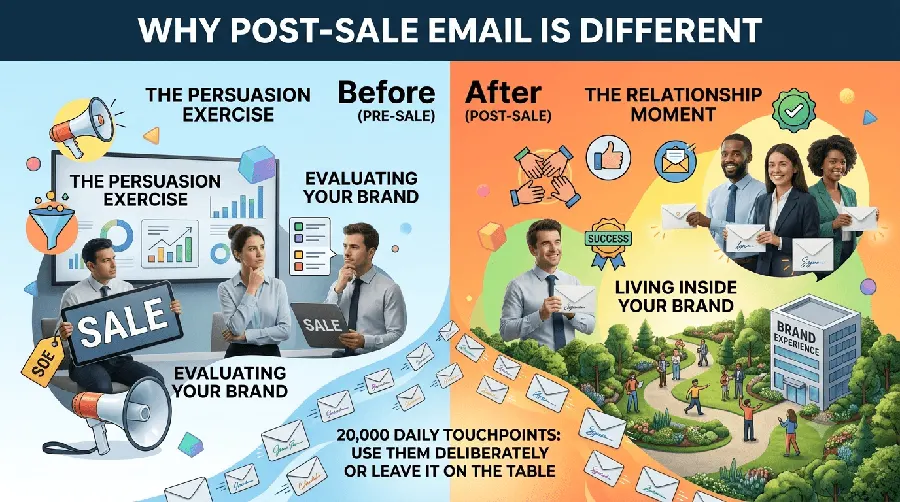
Before the sale, every email is a persuasion exercise. After the sale, the customer is no longer evaluating your brand — they are living inside it. The emails your account managers, customer success teams, and billing departments send are no longer marketing touchpoints in the traditional sense. They are relationship moments. And every one of them carries a signature.
A company with 500 customer-facing staff sending an average of 40 emails per day generates 20,000 customer touchpoints daily. The question is whether you are using that channel deliberately or leaving it on the table.
The hidden cost of signature neglect
Most organizations have no post-sale signature strategy because no single team owns it. Marketing owns pre-sale content. Customer success owns the relationship. IT owns the platform. The signature falls into the gap between all three, and the result is predictable:
- Onboarding customers receive generic signatures that lack contextual support links, CSM contact, and reassurance during the most fragile window of the relationship — the very moment when quiet disengagement begins.
- Expansion-stage accounts get the same signature as day-one customers, missing a low-friction opportunity to surface case studies or ROI resources at exactly the moment the customer is open to deepening their investment.
- Renewal-window communications look identical to routine service emails, squandering the chance to make accumulated value visible when the customer is forming the opinion that will decide whether to sign again.
This is not a technology problem — it is a strategy problem. And it is one that tailoring email signatures for different audiences directly addresses by aligning signature content to the relationship stage of the recipient, not just the role of the sender.
Mapping the Signature to Each Post-Sale Stage
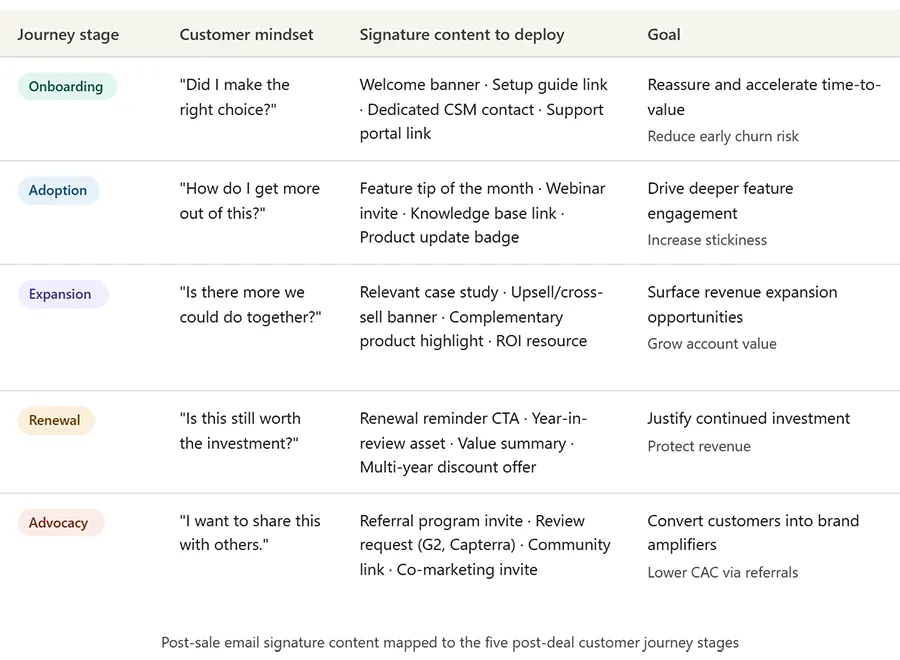
The customer journey does not end at the contract signature — it simply changes shape. There are five distinct post-sale stages, each with a different customer mindset, each requiring different signature content to move the relationship forward. The content below maps each stage to the right content strategy.
Getting this right operationally requires brand consistency in the age of hybrid work to be treated as a governance priority. When onboarding, customers receive emails from multiple people across your organization, and each looks and feels different; it fragments the experience and undermines confidence at precisely the moment when confidence is most fragile.
Onboarding: The Moment That Matters Most
The first 90 days after a deal closes are the highest-risk window for churn. Customers who have not yet achieved a tangible outcome are the most likely to disengage — and disengagement at this stage is rarely dramatic. It is quiet. They stop logging in. They file a support ticket that goes unresolved for a week.
During onboarding, the email signature is a reassurance device. Every email your team sends should carry a pointer to support resources, a link to the onboarding hub, and the name of a specific person who owns the relationship. Nothing reduces early churn risk more than a customer knowing exactly who to call when something is not working.
What an effective onboarding signature should carry
The difference between a passive onboarding signature and an active one comes down to intentionality. At a minimum, it should include:
- A direct link to the customer's onboarding portal or setup guide, so that every routine email becomes an implicit reminder that help and progress are one click away — reducing the friction that causes new customers to stall before reaching first value.
- The name and direct contact of a designated relationship owner, making it immediately clear there is a real, accountable person behind every communication — not just a support queue that feels anonymous and slow.
- A welcome banner during the first 30 days — something as simple as "Welcome — your onboarding team is here" — that signals attentiveness and sets a warm tone before the customer has formed a negative impression.
Adoption and Expansion: Turning Users Into Power Users
Once past onboarding, the objective shifts from reassurance to deepening. The danger at the adoption stage is not immediate cancellation — it is plateau. Customers use 20 percent of what they are paying for, derive just enough value to stay, but never reach the engagement level that makes the relationship sticky enough to survive a competitor's pitch.
A monthly feature highlight in the signature — a single line pointing to one underused capability or a how-to webinar — keeps product discovery alive across every routine communication without requiring a dedicated campaign. At the expansion stage, the content shifts toward surfacing adjacent value: a relevant case study, a complementary product banner, or a link to an ROI benchmark report. This aligns with what email signatures can do as embedded sales assets — surfacing commercial opportunity in a context that feels nothing like a sales call.
Pro tip: Use conditional signature rules to ensure upsell banners are shown only by account managers and customer success staff — not by billing or support teams, where the context would feel off-brand and intrusive.
The Renewal Window: Your Most Critical 90 Days
Renewals are won and lost long before the renewal date appears on a calendar. The email signature in the pre-renewal window has one job: making the accumulated value of the relationship visible. This is the moment for a "year in review" asset linked from every senior contact's signature, or a soft renewal CTA embedded naturally in ongoing service communications rather than arriving as a cold automated notification.
Renewal signatures and the recency effect
Understanding the recency effect in sales communication is useful here. People disproportionately remember the last thing they encountered in any communication. In a renewal-window email, that last thing is your signature. A well-crafted signature at this stage — carrying a value summary or a customer success story — leaves the reader on a forward-looking note rather than closing on a name and a phone number.
This connects to whether email signatures can genuinely influence customer trust — and the evidence says they can, in both directions. An inconsistent or outdated signature at a sensitive relationship moment communicates the same neglect as a slow support response.
Advocacy: The Signature as a Referral Engine
Customers who have achieved genuine outcomes will recommend you — but only if you make it easy. A referral program link, a review invitation, or a community prompt in the customer success team's signature plants that seed without any sense of hard sell. It works precisely because it arrives inside an ongoing, trusted relationship rather than a standalone campaign. This is also how email signatures naturally extend employee advocacy and brand visibility without requiring a formal program running in parallel.
The Operational Reality: Making It Work at Scale
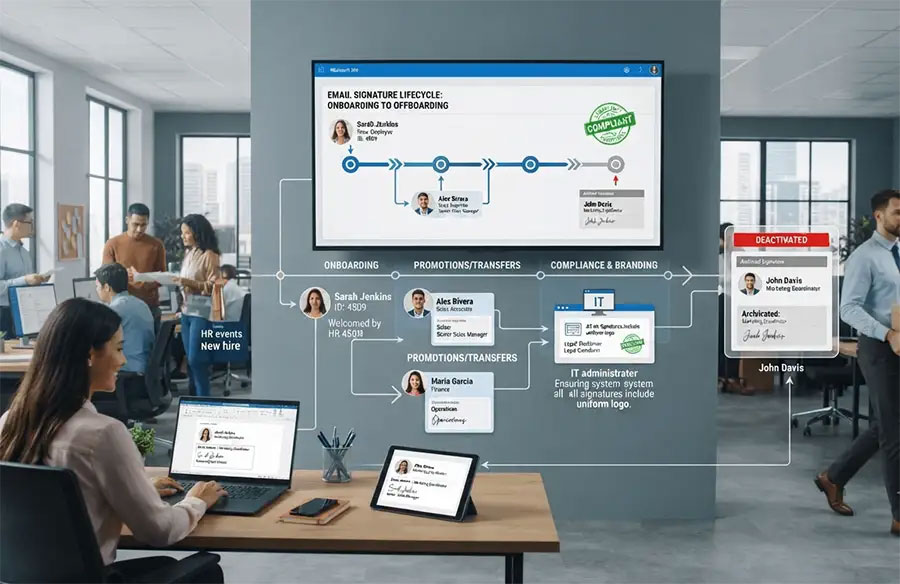
None of this matters without central control. Post-sale communications span dozens of teams, hundreds of individuals, and multiple email platforms. Without a centralized system, the strategy above cannot be executed consistently. Someone in billing runs a banner from eight months ago. A CSM has a typo in their number. A support agent on mobile sends emails with no signature at all.
Centralized signature management eliminates the most common mistakes companies make with email signatures — inconsistency, non-compliance, and outdated content — by allowing a single administrator to define templates by role, team, or relationship stage and push updates across thousands of mailboxes instantly. It also addresses compliance: regulated industries require mandatory disclosures in every client communication, which is why the role of centralized management in regulated industries has grown into a genuine governance function, not just a design convenience. For IT teams, the enterprise playbook for scaling signatures without chaos offers a practical framework for getting there.
Closing: The Signature Is a Relationship, Not a Footer
At enterprise scale, the post-sale email signature is a daily, zero-marginal-cost channel that reaches every customer you have, through the people they already trust, in conversations already happening. Mapped to the post-sale journey — onboarding, adoption, expansion, renewal, advocacy — it becomes a quiet but persistent force for loyalty.
Crossware is the world-leading centralized email signature management platform for Microsoft 365, Google Workspace, Microsoft Exchange, and HCL Domino. Trusted by over 200,000 businesses globally, Crossware gives marketing, IT, and customer success teams the tools to deploy stage-appropriate, brand-consistent signatures across the entire organization — without relying on individuals to get it right. If your post-sale communications channel is sitting idle, Crossware's platform is built to change that.