50,000 Emails a Year: Is Your Signature Working?

What if your most frequently used marketing channel has been running on autopilot for the past three years — and nobody noticed?
That is not a hypothetical. For most organisations, it is the reality. The average employee sends between 30 and 40 emails every working day. Across a team of 50, that adds up to roughly 50,000 emails a year — each one carrying a signature at the bottom. And yet, for the overwhelming majority of businesses, those signatures have never been evaluated as a communication asset. They were set up once, never touched again, and are quietly doing one of two things: reinforcing your brand and generating real value, or undermining it in ways you cannot easily see.
The good news is that fixing this does not require a rebrand, a new marketing budget, or a lengthy IT project. It requires clarity on what a high-performing signature actually looks like — and the right system to deploy it consistently. As we break down the science of first impressions through email footers, the decisions you make about your email signature have measurable psychological effects on how recipients perceive your organisation — before they have even read a single word of your message.
The Signature Nobody Is Looking At (Until Something Goes Wrong)
Most employees treat their email signature the same way they treat their voicemail greeting — set it once and forget it. That is understandable. It feels like a small thing. But small things, multiplied across thousands of emails and dozens of employees, stop being small very quickly.
Think about what an outdated or poorly designed signature actually communicates. An old phone number tells a client you are disorganised. A missing logo on a mobile email suggests your IT infrastructure does not extend to basic brand governance. A jumble of different signature styles across the same team signals that nobody is in charge. None of this is fatal on its own, but it accumulates. Over hundreds of interactions, it builds a subconscious picture of your organisation — and not the one you would choose.
The flip side is equally true. A clean, consistent, well-designed signature builds trust without ever demanding attention. It works in the background, reinforcing your brand with every send. That is what the branding space you forgot is really about — not a design exercise, but a brand discipline that compounds in value the more consistently it is applied.
The Signs Your Signature Is Working Against You
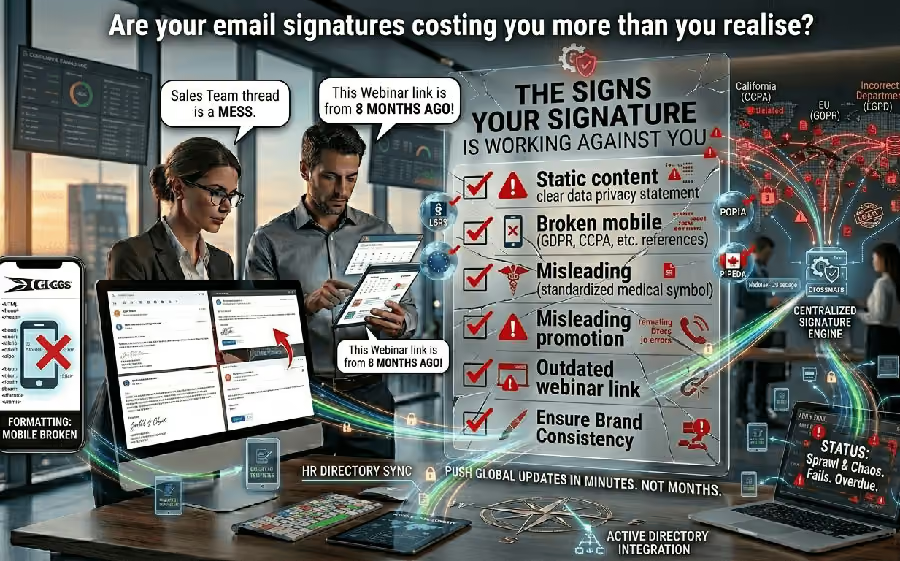
Not all signature problems are immediately obvious. Some are hiding in plain sight, and a few only surface when a client or prospect says something. Here are the most common indicators that your signatures are costing you more than you realise.
- Inconsistency across the team: Open a thread between your sales team and a prospective client. If no two signatures look the same — different fonts, different logos, different layouts, some with photos and some without — you do not have a signature strategy. You have a collection of individual preferences masquerading as one. To any recipient paying attention, it raises a quiet but real question: how organised is this company?
- Static content on a dynamic channel: If your signature still promotes a webinar from eight months ago, links to a blog post you published in 2022, or carries a banner for a product you no longer sell, it is not just irrelevant — it is actively misleading. A signature that never changes is a missed opportunity every single day.
- Broken formatting on mobile: More than half of all business emails are now opened on mobile devices. If your signature was designed for desktop and nobody has checked how it renders on a phone, there is a good chance it is displaying as a wall of broken HTML, a stretched logo, or simply a blank space. That is the last impression you want to leave on a client who opened your email on the way to a meeting.
What a Signature That Works For You Actually Does
A signature that is genuinely earning its place does more than display your name and job title. It functions as a quiet extension of your marketing operation — consistent enough to reinforce trust, flexible enough to carry a current message, and smart enough to adapt to context.
The most forward-thinking organisations have started treating email signatures the way they treat other owned media channels: with a content strategy, a refresh cadence, and measurable goals. Crossware's piece on turning your email signature into a marketing asset lays out exactly how this works in practice — from rotating campaign banners to targeted CTAs based on the sender's department or role.
This does not mean cluttering your signature with every promotion your marketing team dreams up. The best performing signatures are disciplined. They have one clear call to action, not five. They use whitespace deliberately. They load quickly on every device and every email client. They look the same whether sent from Outlook on a laptop or Gmail on a phone.
Before and After: What the Difference Looks Like in Practice
It helps to make this concrete. Consider two versions of the same organisation's email communications — separated not by a rebrand, but purely by how their signatures are managed.
BEFORE — A 200-person professional services firm. Signatures managed individually by each employee. Fifteen different logo versions in circulation. Three employees still using the old domain from a rebrand 18 months ago. Sales team signatures missing the legal disclaimer required by their industry regulator. No mobile optimisation. No campaign banners. No measurement. Approximately 4,000 emails sent daily, each one an unrealised asset.
AFTER — The same firm, six weeks later. Centralised signature management deployed across all 200 users. One approved template, automatically populated from Active Directory. Campaign banner promoting their latest thought leadership piece, updated monthly by marketing without IT involvement. Legal disclaimer applied universally. Mobile-optimised layout rendering correctly on all clients. Click-through on the banner averaging 3.2% — roughly 128 engaged interactions per day from emails that were already being sent anyway.
The difference between those two states is not creative genius or marketing budget. It is governance. And as Crossware's overview of email signature best practices for sales teams illustrates, even modest improvements in signature consistency and relevance produce measurable shifts in how prospects engage.
The Four Things Every High-Performing Signature Gets Right
Across organisations that have genuinely solved the signature problem, four elements consistently separate the ones that work from the ones that do not.
- Consistent brand presentation across every employee and every device: Not approximately consistent — precisely consistent. The same logo, the same font, the same colour, the same layout. Every time, for every person. This is only achievable through centralised deployment, not through templates and hope.
- A single, relevant call to action: Not a list of social icons, a blog link, a product page, and a promotional banner all competing for attention. One clear next step — calibrated to the sender's role and updated regularly to reflect what actually matters right now.
- Accurate, directory-driven contact details: Name, title, phone, office location — pulled automatically from your HR or directory system, so they update when people change roles, move offices, or join the organisation. No more signatures with a former colleague's extension or a phone number that goes to voicemail.
- Compliance built in, not bolted on: Whatever your industry requires — a confidentiality disclaimer, a regulatory reference, a data protection notice — it should be non-negotiable and non-removable. Not something employees add if they remember, but something the system applies automatically to every outgoing email.
The Questions Worth Asking About Your Signatures Right Now
Most organisations have never formally audited their email signatures. They have no idea what percentage of employees are using the current template, what the signatures look like on mobile, or whether any of them include the required legal language. A simple internal audit — send a test email from ten different employees and review what comes back — tends to be a revealing exercise. As Crossware's guide on how to measure the ROI from your corporate email signature points out, you cannot improve what you have not measured — and most organisations start that measurement process with a simple audit that surfaces more issues than they expected.
Three questions are worth starting with:
- What does your signature actually look like across different devices and email clients?: Check it in Outlook, Gmail, Apple Mail, and on Android and iOS. If it looks different in more than one of those environments, it is not optimised — and a significant portion of your recipients are seeing a broken version.
- When was the last time any element of your signature was updated?: If the answer is 'when we onboarded' or 'I honestly don't know,' that is your answer. A signature carrying 18-month-old content is telling every recipient that currency is not a priority for your organisation.
- Who owns your email signature — and do they have the tools to manage it?: Ownership without capability is just liability. If your IT team is responsible for signatures but has no centralised platform to manage them, consistency is not achievable at scale. If marketing owns the content but cannot push updates without going through IT, the refresh cycle will always be too slow.
50,000 Emails Is Not a Small Number
Here is the uncomfortable truth about email signatures: every organisation is already running this channel. The emails are already going out. The signatures are already there. The only question is whether that output is being managed intentionally or left to chance.
At 50,000 emails a year — or 500,000, or five million for a large enterprise — the cumulative impact of getting this right is significant. Better brand recall. Higher engagement on campaign banners. Cleaner compliance posture. A more professional impression across every client relationship. None of that requires a large investment. It requires treating the email signature as what it actually is: a channel that deserves a strategy. For organisations just getting started, Crossware's guide on using email signatures to boost employee advocacy and brand visibility is a practical place to begin — shifting the conversation from 'what our signatures look like' to 'what our signatures are doing.'
Your signature is already showing up 50,000 times a year. The only real decision left is whether you want it working for you.
Ready to find out what your email signatures are really doing? Visit www.crossware365.com for resources, case studies, and practical tools to help you turn every outgoing email into a consistent brand moment.