Why Your Email Signature Should Keep Changing

Most enterprise marketing teams would never publish the same blog post every week for an entire year. They plan editorial calendars, coordinate campaigns, refresh landing pages, promote seasonal initiatives, and retire content when it becomes outdated.
Yet many organizations treat their email signatures completely differently.
The same banner, the same call to action, and sometimes the same promotional message can remain at the bottom of employee emails for months—or even years. That is a missed opportunity. Every email sent by an employee is another branded touchpoint with customers, prospects, partners, suppliers, and other important audiences.
An email signature should not be considered a permanent piece of stationery. It should be treated more like a small, recurring content channel.
That does not mean changing an employee's name, job title, contact details, or core branding every few weeks. It means refreshing the promotional and informational content around those permanent elements so the signature remains relevant to what the business is actually trying to achieve.
Why Your Email Signature Needs a Content Calendar
Think about the volume of communication produced by a large organization. Sales teams follow up with prospects. Account managers communicate with customers. Executives exchange messages with partners. Consultants answer questions. Marketing teams coordinate campaigns.
Every one of those conversations can carry a relevant message.
A well-managed signature can therefore operate as a continuous distribution channel for the content and campaigns an organization is already investing in. It can promote a new report when that report launches, support an event before registration closes, highlight a product announcement, reinforce a seasonal campaign, or direct customers toward a useful resource.
This is why an email signature should have a calendar.
The calendar does not need to be complicated. It simply answers three questions: What is the business promoting? Who should see it? And when should the message appear?
Research and guidance on using email signatures as a marketing channel similarly positions the signature as more than contact information, particularly when organizations use links, calls to action, and relevant promotional content.
For enterprise marketing leaders, the larger advantage is coordination. Instead of asking employees to manually update signatures whenever a new campaign launches, marketing can plan signature content alongside the broader marketing calendar.
The Signature Content Calendar Should Follow the Marketing Calendar
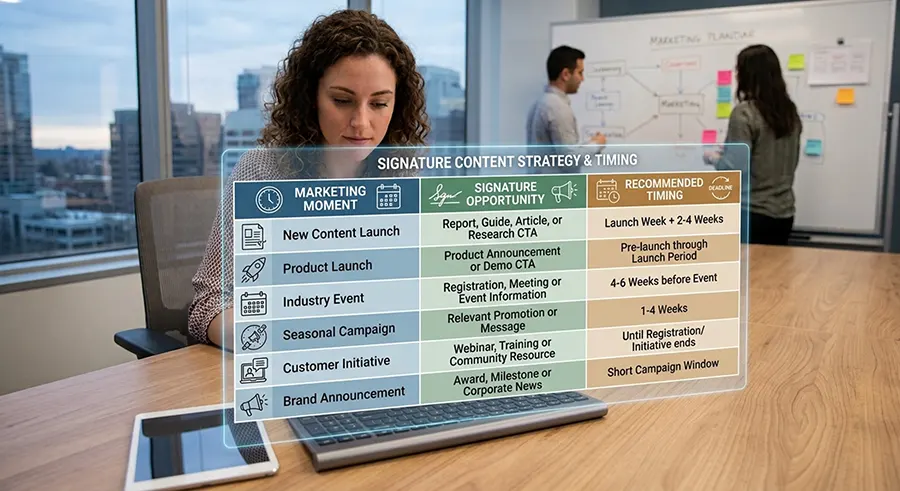
Your signature calendar should not become another isolated marketing activity. It should support campaigns that already exist.
If the company is launching a new product in March, the signature can reinforce that launch. If a major industry event is happening in June, the signature can promote attendance or meetings. If the business publishes an annual research report in September, the signature can help distribute it.
The result is a much more connected customer experience.
The important word is relevance.
A signature promoting a webinar that ended three months ago does not simply become ineffective. It can actively make the organization appear inattentive.
That is why timed signature banners for promotions and announcements can be particularly valuable for organizations running frequent campaigns. Content can have a defined lifespan rather than remaining permanently attached to employee communications.
Think in Campaign Cycles, Not Constant Change
Changing a signature does not mean redesigning it every week.
In fact, constantly changing the core design could weaken brand recognition. The better approach is to establish a stable signature foundation and periodically refresh one strategic content area.
The permanent layer might contain the employee's name, position, company identity, contact details, and required legal information.
The changing layer might contain a banner, promotional message, CTA, event, content recommendation, or corporate initiative.
This creates a useful balance: the brand stays consistent while the message stays current.
For example, imagine a global technology company preparing for a major industry conference. Four weeks before the event, employee signatures could promote registration. Two weeks later, they could encourage recipients to schedule meetings. During the event, the message could focus on the company's presence and key announcements. Afterward, the signature could shift toward event highlights or related thought leadership.
The signature has effectively followed the campaign from awareness through follow-up.
Build the Calendar Around Your Audience
One of the biggest mistakes is assuming that every employee and recipient should see the same message.
An enterprise sales team may need a different CTA from the customer success department. Regional teams may need localized campaigns. Executives may need a more corporate message than technical specialists.
A content calendar should therefore consider both time and audience.
For example, a software company might use the following approach:
Sales: Promote demos, case studies, product launches, and industry events.
Marketing: Promote reports, webinars, research, and thought leadership.
Customer Success: Promote training, customer resources, community events, and product updates.
Executive Leadership: Highlight major company announcements, awards, strategic initiatives, or corporate thought leadership.
This approach makes the signature more useful because the recipient sees content that relates to the person they are communicating with.
Guidance on email signatures for sales and marketing teams emphasizes this opportunity to use signatures for branding, promotion, engagement, and measurement.
Pro Tip: Plan the signature CTA before the campaign launches
Do not wait until a campaign is already live to decide what the signature should promote.
When marketing builds its quarterly campaign calendar, include an additional field for email signature support. This simple step ensures the signature is considered at the same time as social media, paid advertising, website content, and email marketing.
A Quarterly Signature Calendar Is Often Enough
Not every enterprise needs dozens of signature changes.
A quarterly planning cycle can provide enough flexibility while keeping governance manageable. Within each quarter, marketers can identify major campaigns and determine which deserve additional exposure through employee email.
A practical quarterly structure might look like this:
Q1: New-year initiatives, annual reports, product announcements, industry events.
Q2: Conferences, research publications, customer stories, mid-year campaigns.
Q3: Product updates, thought leadership, regional campaigns, industry events.
Q4: Year-end reports, customer appreciation, seasonal campaigns, next-year initiatives.
The calendar can then be refined with shorter campaigns when something important happens unexpectedly.
This is particularly useful for seasonal marketing. Rather than leaving one generic promotional message in place, organizations can align signatures with relevant moments throughout the year. A seasonal email signature strategy can help keep communications timely while supporting broader seasonal initiatives.
Enterprise Example: Turning One Launch Into Multiple Touchpoints
Consider a multinational financial services company launching a new digital service.
The marketing campaign already includes advertising, website content, PR, social media, and a customer email campaign. Instead of treating the employee signature as separate from this activity, the marketing team adds it to the campaign plan.
During the first two weeks, the signature promotes an educational article explaining the market problem the new service addresses.
During the launch period, it changes to a product announcement with a link to the relevant landing page.
During the following month, the CTA shifts toward a customer success story.
After the campaign ends, the promotional banner disappears and the signature returns to the company's next priority.
Nothing about the employee's core identity changes. What changes is the reason for the recipient to click.
That is the difference between a static signature and a content-driven signature strategy.
Measure What Changes
A content calendar becomes considerably more valuable when marketing can determine which messages actually generate engagement.
Track the performance of signature campaigns just as you would other digital campaigns. Click-through rates can indicate which messages attract attention, while downstream website activity can help determine whether those clicks are producing meaningful engagement.
Email signature analytics and performance tracking explains how campaign links and tracking parameters can help organizations understand which signature elements recipients interact with.
The goal is not to create another complicated reporting system. It is to learn.
Perhaps webinar CTAs consistently outperform generic website links. Perhaps customer case studies generate more engagement from prospects than product announcements. Perhaps a particular campaign performs significantly better when targeted to sales employees rather than the entire organization.
Those insights can improve the next campaign.
Organizations can go further by using signature analytics to evaluate return on investment, allowing marketing leaders to move the conversation from “We changed the banner” to “This campaign generated measurable engagement.”
The Biggest Risk: Letting Yesterday's Campaign Become Today's Brand
An outdated signature can be surprisingly damaging.
Imagine receiving an email from a major enterprise and seeing a banner promoting an event that ended months ago. Or clicking a link that leads to a discontinued campaign page. Or seeing a product announcement long after the product has become established.
These details may appear minor, but they contribute to the recipient's perception of how carefully the organization manages its communications.
The solution is simple: every campaign should have a start date, owner, target audience, CTA, destination URL, and end date.
That turns signature management into an accountable marketing process rather than an occasional design task.
Organizations can also benefit from centralized control over company-wide email signatures, particularly when hundreds or thousands of employees need the same campaign message at the same time.
Your Email Signature Belongs on the Content Calendar
Your blog has an editorial calendar because content has a purpose, an audience, a publication date, and a lifespan.
Your email signature deserves the same thinking.
It is not necessary to change the core signature every week. Instead, think of the promotional section as a small piece of owned media that can move with the organization's priorities. Plan it alongside campaigns, coordinate it by department or audience, give every message a defined lifespan, and measure the response.
The payoff is consistency without stagnation.
Every employee email can remain unmistakably on-brand while the message underneath keeps pace with what the business is doing right now. And because signatures appear inside real business conversations, the content reaches people in a context where the relationship already exists.
For enterprise leaders looking to make that process scalable, controlled, measurable, and easy to manage across departments, regions, and thousands of employees, Crossware provides the core solution for centrally managing dynamic email signatures and turning everyday business communication into a coordinated marketing channel.